Showing posts with label Credit. Show all posts

Saturday, February 16, 2008

Racking up credit card debt in college

Racking up credit card debt in college


Did you rack up a big credit card debt in college? You have to remember that it takes a long time to Remove Negative Items from your Credit Report! One of my roommates had $5000 in credit card debt. Of course he also wore polo shirts and designer jeans. I think he also had a car payment. My car cost $700 and lasted me for like 3 years. This video is has some good lessons in it about credit card debt. I like the saying "if you live like a professional in college you will live like a college student after you get out of college." What happens is you have fun paying for things like spring break, dinners out, and material items. You rack up a huge debt and you end up pay for it for a long time. One of my spring break trips consisted of a buddy of mine and I driving to Daytona and Fort Lauderdale and sleeping in the back of our truck. It was great we didn't know any better and we were on SPRING BREAK. The trip was cheap.

Did you know if you have $7000 in credit card debt at 25% interest rate you end up having an interest charge of $1750 per year! That $145 per month just in interest that doesn't even count the principle payments.

A few guidelines to remember and these don't just apply to college students.

  1. Don't pay for things that don't last more than a few years with a credit card if you are unable to payoff the card each month. For example, if you don't have the money for the dinner out. Don't put in on the card.
  2. Don't borrow money long term from a credit card company. Borrow money from a bank not a credit card. The rates are much, much lower.
  3. If you cannot get credit borrow money from your parents or relatives. When I say borrow I really mean it. You have to keep track of what you owe them and have a written agreement on how you are going to pay them back.


Related articles:

  1. Finding Cheaper Loans
  2. How to stop using credit crds and getting out of debt

Thanks for visiting and feel free to leave a comment or idea. By the way I am running a little survey to get my readers opinion on what items I should write more about so please take the survey, it is over on the left hand side of the page. Also for related articles check out the tags below. You might find something usefull. If you enjoyed this post please Subscribe to Strategies for Life.

Monday, February 11, 2008

How to Negotiate with Your Credit Card Company

How to Negotiate With Your Credit Card Company
Are you afraid to call your credit card company and ask for a lower rate? Are you tempted to call one of those debt consolidation outfits on the internet and ask for help? Why not try it yourself first. You see if you run a balance on your credit card the credit card company is making boat loads of money off of you. They don't want you to leave. Why not give them a call and ask for a lower rate. Check out this example below on how to ask for a lower rate.

For additional reading check out the following book, Talk Your Way Out of Credit Card Debt!: Phone Calls to Banks That Saved More Than $43,000 in Interest Charges and Fees


Related articles:

  1. Finding Cheaper Loans
  2. How to stop using credit crds and getting out of debt

Thanks for visiting and feel free to leave a comment or idea. By the way I am running a little survey to get my readers opinion on what items I should write more about so please take the survey, it is over on the left hand side of the page. Also for related articles check out the tags below. You might find something usefull. If you enjoyed this post please Subscribe to Strategies for Life.

Saturday, December 01, 2007

Avoiding Christmas Debt


Avoiding Christmas Debt - Tips To Avoid Sinking Into Holiday Debt

Do you set a budget for your holiday spending? Unfortunately it is easy to over do it during the holidays in many ways. Weather it is eating too much stuffing or drinking too much eggnog is one thing. Buying too many gifts on your credit cards is another. Did you start that Christmas club savings fund to help out in paying for you Christmas bills?


It is easy to get carried away with Christmas debt. However, with some self-discipline you can help keep your purchases to a manageable limit. The key to success it setting a limit to your Holiday Credit Card Purchases. Credit cards are only an illusion that can buy more gifts than you actually can afford. Here's why you should limit your credit cards purchases this holiday season. Gifts bought on credit end up costing more.
.
The best laid plans.... Unexpected post-holiday expenses might postpone your credit card payment plan, lengthening your credit card debt. By sticking to a few spending principles, you can keep your holiday spending to a minimum and avoid paying for holiday gifts until the next holiday season.


How To Avoid Christmas Debt

When you've made the decision to keep your credit card purchases within a reasonable limit, here's how to put it into practice.


  1. Save up. Spending cash instead of using credit for your holiday purchases allows you to avoid holiday debt all together. If you haven’t started saving, put aside something each paycheck starting now and use that to finance your holiday purchases.

  2. Set a budget before you shop. Setting a spending limit and sticking to it will keep you from overspending. Be disciplined and don’t go over your budget, no matter what.

  3. Make a list. Santa makes a list and checks it twice, so should you. Even though you might feel compelled to splurge on everyone in your life, you don't have to. People appreciate simple and meaningful over expensive and useless.

  4. Don't shop for yourself. Avoid the "one for you, one for me" shopping mindset. You'll end up spending double what you would had you shopped only for the loved ones in your life.
    Ignore "big" sales. More often than not, they're not really sales at all. Those "Buy 2, Get 1 Half Off" deals only trick you into buying more than you would otherwise. Remember, stick to your list.

  5. Shop online first. The internet makes it easy to shop around. It also makes it harder to buy on impulse. Since most retailers have inventory on their websites, you can decide exactly what you want to buy before going to the mall.

  6. Leave your credit cards at home. Without your credit cards, you’ll have a hard time charging them up. If you must use credit for your purchases, pick one credit card and stick to your spending budget.

  7. Don’t buy if you can’t afford to pay. Keep in mind that when you use credit, you’re borrowing from your future income. You know your finances better than anyone. Only charge what you can afford and you’ll avoid paying on your holiday debt until the next holiday season.

Saturday, November 17, 2007

How to stop using credit cards - getting out of debt


How to stop using credit cards - getting out of debt
Now what you have worked yourself into a corner with over using your credit cards? It is a common problem, many people are struggling with personal credit card debt. Plastic is just too easy, and on top of it all, unless you look at your past statements you can't remember what you spent all the money on. Now when you go to some places if it is below $25 they don't even have you sign anymore, they make it too easy to use your credit card. In fact, I crossed the boarder the other day and I could go to the credit card only lane, when I came back on the other side they didn't have a credit card only lane and I was kinda disappointed. Another example, I went to park at the airport the other day and you can't even get into the parking lot with out a credit card.

Here are some simple steps to follow to help you stop using credit cars:
  1. The first step is to talk with direct family members about the situation. All family members must agree to reduce spending until your family is out of this crisis. This should mean closing charge accounts and not using credit cards. If you feel the need to use plastic switch to a debit Master Card or some other debit card which only works if you actually have money in your checking account.
  2. You should contact creditor(s) and explain your situation to them. Try to get them to work out a plan so that obligations are repaid. Most credit card company's would rather have you pay them back then default on the loan and stop paying your bill.
  3. A lot of experts will recommend the you not carry your credit cards with you and to just leave them at home. This is easier said than done in a lot of situations. Again based on my stories above at the airport and bridge. The idea is if you want to use them, you will have to go home and then return to the store. If the item you want to buy is a necessity then you will have access to the credit. If it is an impulse purchase you have the travel time back home to reconsider.
  4. Keep your credit card limits low, if you have a $500 or $1000 limit and you can not pay that back, what makes you think you can payback $2000 or $5000? The key is, if you are already having issues paying back your debt on a low limit, then don't ask for credit limit increases. This is a solution that many try that ends up in disaster in the long run.
  5. Some experts say don't use credit for consumable items such as food if you do not pay in full each month. I agree witht this comment, but is is so easy to do. I also think that you should not pay for things over time on a credit card. Probably the most important rule, don't borrow money from a credit card borrow money from a bank. I wrote another post called finding cheaper loans that I suggest you check out.
  6. Do you ever hear those commercials on the radio about debt consolidation? Do you ever wonder how they can advertise so much? Most consumer finance companies that offer this service charge very high interest rates. These companies will appear to be your friends but you need to watch it very carefully. If you are not good at understanding contracts, or even if you are you should have a family member or friend look over the contract first with you to make sure you understand what you are getting in to. I would suggest you look for a company that is really a not for profit debt resolution company. You won't hear these guys advertising on the radio because they don't have tons of profit to spend on advertising. Funny how that works.
  7. Debt guidline: If you have more than 15 percent of your disposable income in debt payments, you should take steps to reduce your credit use. Disposable income is your net income after taxes and other payroll deductions. So lets do the math, if you bring home $1000 per month then you should not have more that $150 a month in debt payments. This doesn't mean that you are just making minimum payments either because you will never pay it off and you really won't be able to borrow any more. Remember the credit card companies don't care if you ever pay it off as long as you are making the minimum payment.
Thanks for visiting and feel free to leave a comment or idea. Also for related articles check out the tags below. You might find something usefull. If you enjoyed this post please Subscribe to Strategies for Life.

Tuesday, November 13, 2007

Finding Cheaper Loans

Find Cheaper Loans

A popular topic of mine is how to get out of debt and paying off your credit cards, so it seems a little funny to me to be talking about finding cheaper loans. However, use of debt is required by most people and if used properly most people will have a better life with some debt vs. without debt. Personally, I feel that debt should only be used for bigger purchases like homes and cars. Also when you can afford them some toys like a boat or and RV. However, on the toys I encourage you to buy a nice used one and pay cash for it or take out as small a loan as you can or as short a time period as you can. The key thing to remember is the loan for the toy last a lot longer then the initial euphoria of getting the new toy.

Updated with news story on Payday loans and their dangers.


Anyway, I am rambling, let get to the point you are reading this article to find out how to find cheaper loans. The WSJ had an interesting article on the fact that credit unions generally have cheaper rates on car loans, personal loans, credit cards, and home equity loans. For instance the average 48 month car loan at a credit union is at a credit union is almost 2% lower per year than most banks.

Credit unions can provide you with cheaper loan rates because they don't pay income taxes. On the other hand banks have to pay these income taxes. Credit unions were orginally designed to cater to the savings and lending needs of lower to middle class consumers that were ignored by traditional banks. Generally, you had to work for a particular company or live in a particular area to be able to join the credit union. Not anymore, most credit unions are open to virtually anyone. If you are looking to find a credit union in your area you can search by zip code at CUNA's Website.

Paying for that flat screen TV: A lot of people will be getting new flat screen TVs this year as prices fall. Most will be tempted to put it on the plastic. Remember if you put it on a credit card you will start incurring finance charges after the first month that you do not pay the balance. Usually this will be at a very high rate, 18 to 22%. As an alternative why not finance it through the store you are buying it from. Don't sign up for the no payments until next year trick. This will just postpone the problem. I would rather see you buy that big screen TV with a 12 months no interest. Then divide the total cost by 11 and make that payment each month. I say 11 because a lot of times this type of financing is also a trick. Sometimes you have to pay the thing off before 12 months or you incur finance charges on the whole balance even though you made payments. So here is the simple math for example:

  • Say you bought a Sharp LCD 42 inch 1080p HD TV total price out the door was $2200.
  • 2200 divided by 11 is $200 per month.
  • When the bill comes each month right the check for $200. If you can do more that would be even better. $225, $250, $300 whatever, just pay the thing off. Remember if you do it this way it really does allow you to buy someting on time and it doesn't cost you a penny more.

If the store you are shopping at doesn't have this type of financing then shop around. You will find a store that does. As soon as you walk out the door they will improve their offer. You watch.

Related links:

Thanks for visiting please check out my other blogs and websites:

If you enjoyed this post please Subscribe to Strategies for Life. If you would like to tag this post at del.icio.us click here.

Sunday, March 18, 2007

Free credit report? Really?

Interesting article called The true cost of a `free' credit report: $79.95 here is what they said along with my comments.

FreeCreditReport.com is not the place for free credit reports. If you didn't know that, you may have paid for something that you did not want or that should have been free. Apparently the company that operates FreeCreditReport.com had its own sort of confusion. A federal court ordered the company to stop misleading consumers last August. Then last month, the Federal Trade Commission said the company was still not telling customers what it should, under the settlement order. I always wondered what this company was about. After all they pound us with their radio and TV ads and it seemed to good to be true. Last summer I went to their site and started to click through and I noticed that you had to put in a credit card, so I went slow and started reading. I ended up not putting in the credit card number because I could see there was going to be a charge for my free credit report.

In late February, the FTC said Consumerinfo.com, which is a unit of Experian, the credit bureau, didn't adequately disclose that anyone who signed up for the "free" report at FreeCreditReport.com would also automatically be enrolled in a credit monitoring program that costs $79.95. An expensive free credit report as far as I am concerned. Consumerinfo.com paid $950,000 to settle the original charges. Now, the company has to pay another $300,000 for violating that settlement order. Experian spokeswoman Heather Greer said there was a problem in one of the company's television ads that was fixed last year. Meanwhile, if you want a truly free copy of your credit report, the place to go does not have free in its web site address. It's annualcredit report.com. I tried this one and it actually is free. If you want to get your actual FICO score there is a charge for that but I felt I didn't need that.

Where to go for your possible refund: Anyone can use that site to get a free credit report once every 12 months from each of the three credit bureaus. Anyone who was unwittingly charged for credit monitoring by Consumerinfo.com may be eligible for a refund. The settlement covers customers between Nov. 1, 2000 and Sept. 15, 2003. For more information, go to ftc.gov/freereports. Or send a letter to: Consumerinfo, P.O. Box 19729, Irvine, CA 92623-9729.

Saturday, February 10, 2007

How to wipe out holiday debt.

Kiplingers has a great article titled Wipe Out Holiday Debt. Here is what they said along with my comments.

Don't be lured into using a home-equity loan or line of credit to consolidate your bills. Consider these options instead. The holidays are past, and the credit-card bills have arrived. It's time to face the music, and it isn't necessarily jolly. Households with at least one credit card spent, on average, $1,534 this past Christmas, according to CardWeb.com. If you don't happen to have enough cash on hand to pay the entire balance, the Ghost of Christmas Past could haunt you for months or even years to come. For example, if you make just the minimum monthly payment -- $38 to start on a card with an interest rate of 16% -- you'll be paying off your balance until 2020, when you will have handed over $1,471 in total interest. First of all never make just the monthly payment, if you spend $1500 at Christmas and are only going to pay the minimum payment you spent way to much at Christmas. To get a quick view on how long it might take you to payoff your holiday debts start check out this article on financial calculators. You need to have a plan on how to pay off your credit card debt. Second, you need to establish a budget each year for your Holiday spending. I also recommend the you establish a special savings or Christmas club savings account now to help save for 2007 Christmas bills.

Consolidating bills via a home-equity loan or line of credit isn't a silver bullet.
Even if you lower the interest rate, you'll be tempted to simply stretch out the payments. And borrowing against your home has risks you may not anticipate. The best solution is to bite the bullet and pay down the extra debt quickly. You may be able to lower your interest rate simply by calling your credit card issuer, or by transferring the balance to another card. Think twice about home-equity borrowing. Transferring your credit-card balances to a less-expensive home-equity line of credit or loan is an option most financial planners discourage. "I hear all these ads touting how home-equity borrowing will let you 'eliminate debt,'" says Glenda Moelenpah, a financial planner in San Diego. "But they really just let you change it and take on greater risk, too, because you use your home as collateral." Translation: If you can't make the payments, you could lose your home in foreclosure. There is a saying that is in the personal finance world that says never use credit for something that looses value. For example, do you want to pay interest charges on all the dinners you ate out last year? Do you really want to still be paying on the dress that your daughter wore to the dance once? Transfering your bills to a home equity loan only stretches out the problem. Additionally, a lot of people will continue to use this year over year as a place to sweep up all they recent debts into and the problem will continue to grow.

Moelenpah says sales pitches often emphasize the tax deductibility of the interest that you pay. But she points out that the law lets you deduct only the interest on "acquisition indebtedness" -- what you paid for the house -- plus $100,000 of other home-equity borrowing. When you sell, you'll have to pay off any outstanding home-equity debt at closing. If you've borrowed more than the value of the home or if its market value has fallen, you could find yourself "upside down" -- owing the bank money at closing. That's not a happy place to be. Because of those risks, Moelenpah says she's reluctant to advise clients to consolidate debt with home-equity borrowing unless they take steps to avoid having the same problem again next year. My opinion is you need a place to live. I don't want to have to worry about being upside down on my mortgage or thinking about where I am going to live it I had to be foreclosed on. The problem with consolidating the loans and places you home equity on the line is, when you do get in trouble on the home equity side you will never ever remember where the debt came from. Was it the vacation to Florida, Christmas presents, the new flat screen TV, or just enjoying yourself.

If you do go that route, a home-equity loan imposes more discipline than an home-equity line of credit. With a home-equity loan, you get a lump sum and pay closing costs. The loan will require a fully amortized payment of principal and interest every month -- typically over five or ten years. Plus, rates are running a half point lower, on average (currently 8.21%), than on home-equity lines of credit, according to HSH.com.

How to pay it down fast
Rather than take on the risks of borrowing against your home to consolidate your credit card bills, consider these tips for disposing of debt from Money Management International, a nonprofit credit-counseling agency affiliated with the National Foundation for Credit Counseling. Another thing to consider is to sell some stuff online. I think this works great. Every fall my wife and I get busy selling some of our kids old toys, clothes and electronics on eBay. It really helps when you go into Christmas with $500 in the Paypal account. Then we try to buy stuff used on eBay which works out great because it is like we are recycling money. We sold the Nitendo 64 and the money went toward the PS2. Wow what a concept.

Track the damage.
List all your creditors, how much you owe to each and the interest rates. Total it. Post it where you'll see it, and update it monthly. I saw a recent article on how to keep your New Years resolutions and it talked about posting your goals on the refigerator. I thought that was a good idea. I suggest the bathroom mirror as well. That way when you decide you are going to go out and party this weekend, you might remember to not put it on the credit card. Set a mini budget for the weekend of say $40 and then thats it. When it is gone you have to stop. Don't keep increasing the problem.

Create a budget and a 90-day repayment plan.
Figure out where you can cut and apply the extra funds toward your debt (see Build Your Budget for help). In the example above, you'd have to come up with $525 a month to pay off the debt in three months, and you'd pay $41 in interest. If the best you can do is $250, it will take you seven months and cost you $78 in interest. You know it is funny how you meet people that complain about being broke all the time and you find that they have a $60 per month cell phone bill, digital cable of $100, go to the movies all the time and wear only designer clothing. If you are paying off credit card debt it might be time to cut back and free up some cash. Switch to a pay as you go cell phone and don't use it much. Drop down to basic cable only and subscribe to Netflix for $9.99 per month. You really never watch all the stuff on digital cable anyway. Try buying a pair of shoes that is not a brand name and above all just plain cut back on the spending.

Hide your credit cards.
If you have to use credit, don't charge anything you can't repay in 90 days. Not only do you need to hide the credit cards, you need to stay out of the stores. It is always amazing to me how we will goto the store for bread and milk and we come out and the bill was $90. How does that happen. One thing you also need to do is when you are shopping work off a list and don't buy anything that is not on your list. It is a tough thing to do and you need discipline but it will help.

Pay strategically.
Make at least the minimum payment on all your cards to avoid late charges and any sudden increases in your interest rate. Dedicate extra funds to the cards with the highest interest rates. I really think if you are juggling multiple credit cards you need to consider some type of debt consolidation. I am not recommending a home equity loan but getting 5 or 6 different credit card bills per month can be very frustrating and hard to juggle.

Reduce your interest rate
The lower your interest rate, the more your monthly payment goes to pay down the principal you owe. This might be a good time, especially if you have a good credit record, to ask creditors to lower your interest rate. Scott Bilker, founder of DebtSmart.com, suggests letting the bank know that it will lose you as a customer if it doesn't. If they say no the first time, try again. You might score with a different customer service rep. Or you could transfer your balance to a card offering a 0% introductory rate -- but only if you'll repay your debt fully before the rate rises. Most people might be reluctant to do this type of negotiations. Consider finding a cheaper loan source like a credit union. Consolidate everything into one personal loan and the stop taking on more debt.

Get ahead of the game
To avoid the specter of holiday debt next year, credit counselors recommend that you start saving now. Hey, I already said this about setting up special savings or Christmas clubs. Here is how you do it. Divide what you spent this year by 11 (February through December), and stash the result each month in a savings account. A Christmas Club account at your bank or credit union won't pay much interest, but it will impose a penalty on any withdrawals before the holidays. If you're disciplined, you could open an account with HSBC Direct, which pays 5.1% interest, or ING Direct, which pays 4.5%. Remember this has to be done automatically, you will not have the discipline to save it manually, have your pay check deposited into your checking account and the special savings withdrawn directly from your checking account each month.

Do you look forward to large annual income-tax refunds that you use to pay down your credit-card debt in a lump sum? Moelenpah says a better strategy is to adjust withholding downward and apply the extra monthly income to your credit-card debt. And Moelenpah offers this "radical" approach to gift giving if you're carrying credit-card debt: "Maybe next year you can't afford to buy any gifts," she says. "Of course, that doesn't mean you can't give them." A box of homemade cookies may be more meaningful than another cashmere sweater, and you won't be paying for it for the next 20 years. Another thing to think about on gift giving is to set a limit. It is incredibly hard to buy something for everyone that is under $20. However, maybe that is what you have to do this year. If you don't want to disappoint your kids really consider buying used stuff. You kids won't care if the get a used Sony PSP. They really just want a PSP. Good luck and pay it down fast.

Friday, February 02, 2007

Top 6 How to Finance Articles


A few great articles on personal finance that I discovered at Digg.com. The first on from Yourcreditavisor.com which is titled 102 Personal Finance Tips Your Professor Never Taught You is a great article covering everything from taxes to debt to eduction. Check it out. This article refers to what they didn't teach you in high school but I also think it refers to college as well check out 101 Financial Tips you Never Learned in High School (but should have) which is from Bankruptcy Reader. A very popular question that is usually asked by someone who doesn't have a job is how to get rich so make sure you stop by at 25 Rules to Grow Rich which is from CNN. The leasons from Mom. You know it is hard to replace good old Mom, I try to call her everyday so don't miss out on 46 Things I Wish My Mom Taught Me About Money. Everyone wants to know how to save money, so here are 88 Tips To Save Money. If your a student or a parent trying to pay for college you can go wrong by reviewing this article on 117 Creative Ways for Students to Pay for College.

Sunday, July 30, 2006

Mirco loans at Kiva.org

Micro loans for your business check out Kiva.org

A popular question from my readers is where to find obtain a loan for a small business. The funny thing is the logical answer would be to check with your bank, however, banks don't like risk and loaning money to small businesses is risky. I recently read an article about a website cal Kiva.org. Kiva provides small business wannabees with an avenue to find loans from not traditional loan sources which generally means private individuals.


How does Kiva work: Basically, the prospective small business post want ads indicating the type of business loan that they need and a description of their business. Generally the small business owners is planning to repay the loan through profits generated by the business. The repayment time frame is usually 9 to 16 months.

How is Kiva different then Prosper.com: Kiva focuses on letting you loan to the working poor around the world. By specializing in loaning money to unique small businesses in the developing world you can "sponsor a business" and help the world's working poor make great strides towards economic independence. On the otherhand Prosper basically anyone around the world can request a loan for almost any situation. Basically, you are loan the money as a good will gesture. You are giving something back to the world community and helping the less fortunate.

Kiva has only been open for business for 5 months, however it has already fund 450 small business with over $200,000 in loans. The cool part is that all of the repayment transactions are handled automatically by Paypal.com.

Related links:

Thanks for visiting please check out my other blogs and websites:

If you enjoyed this post please Subscribe to Strategies for Life.

Saturday, July 22, 2006

What is a FICO score

What is a FICO score?

Thinking about buying a house, leasing a car, or taking on some other type of debt? When you apply for a loan, a credit card, car loan, or mortgage, the banks or lenders want to know what risk they'd take by loaning money to you. Higher FICO scores means you have good credit, lower scores may mean you have poor credit and are a higher risk. Are you looking for ways to Raise your FICO Score.

FICO® scores are the credit scores most lenders use to determine your credit risk. You have three FICO scores, one for each of the three credit bureaus: Experian, TransUnion, and Equifax. Each score is based on information the credit bureau keeps on file about you. As this information changes, your credit scores tend to change as well. Your 3 FICO scores affect both how much and what loan terms (interest rate, etc.) lenders will offer you at any given time. Taking steps to improve your FICO scores can help you qualify for better rates from lenders.

FICO scores are designed to measure the risk of default, by taking into account various factors. Although the exact formula for calculating the FICO score is a closely guarded secret, the following components and the approximate weighted contribution of each:

  • 35% punctuality of payment in the past
  • 30% capacity used: the ratio of current revolving debt (credit card balances, etc.) to total available revolving credit (credit limits)
  • 15% length of credit history
  • 10% types of credit used (installment, revolving, consumer finance)
  • 10% recent search for credit and/or amount of credit obtained recently

If you would like to get an estimate of your FICO score you can to the FICO Esitmate calculator at Bankrate.com.

Related links:

Thanks for visiting and feel free to leave a comment or idea. By the way I am running a little survey to get my readers opinion on what items I should write more about so please take the survey, it is over on the left hand side of the page. Also for related articles check out the tags below. You might find something usefull. If you enjoyed this post please Subscribe to Strategies for Life.

Monday, July 10, 2006

Get your free credit report

How to get a free credit report

Probably the most advertised free credit report service is http://www.freecreditreport.com. However, I tried the site and I couldn't figure out a way to actually get a free credit report. The other day I was driving home from work and I heard a news story about actually getting a free annual credit report. This one actually works and you do not have to put in a credit card. Unfortunately, you do need to put in a social security number but I guess that makes sense.

The site is called https://www.annualcreditreport.com/cra/index.jsp it provides a yearly free credit report from Equifax, Experian, and TransUnion, in order to monitor credit history and guard against identity theft. I tried the service and it works. It is amazing how many different credit cards and lines of credit at different stores you accumulate over the years. It is probably a good idea to go through the list of lines of credit and credit cards and cancel them. Some of them I didn't even remember opening.

Anyway it is a good way to get your free credit report on line. You don't have to pay for it. Of course they have all kinds of options that you can buy like subscribing to a service that informs you if your credit score has changed additionally in order for you to get your FICO score they also want to charge you something like $6.95. Not sure why they do that.

Related links:

Thanks for visiting please check out my other blogs and websites:

If you enjoyed this post please Subscribe to Strategies for Life.

Saturday, June 24, 2006

Top 10 ways to improve your credit scores

Top 10 ways to improve your credit scores

I read and interesting article at About.com on how to improve your credit score. Here is a summary of what they said.

  1. First of you should understand what goes into the calculation of your credit score, and after you do that you can develop a plan for improving your score. You can get your credit score from different places on line however, probably the easiest way to do it is to go to a bank and get prequalified for a loan and they will run the credit report for you. I have looked at some of the free credit report companies online and I am concerned about giving them my social security number and my credit card information. If they say free credit report then why do they need my credit card number?
  2. After you have a copy of your credit report, review it carefully and look for errors and if possible correct any significant errors. It was amazing to me one time we went to apply for a home loan and they said we had a late payment. I was pretty shocked and it turn out it was a stupid department store bill that we had forgotten to pay one month and they immediately turned us in as a late pay. Since then I have pretty much refused to have any more department store credit cards, gas cards, etc.
  3. Pay your bills on time. Of course this goes without saying as the most important thing that you can do to maintain and improve your credit score.
  4. Don't open a lot of new accounts over a short time period, especially if you have a short credit history. This ties into point number 2, if you have a Visa why do you need a department store card and a gas cards and a Lowes card, etc. Additionally, if you search around you can get a Visa or Mastercard that pays you rewards.
  5. Shop for credit over a short period of time. FICO scores distinguish between searching for credit for a specific loan and searching for lots of different credit lines. I wasn't exactly sure what this meant however, I believe what happens is if you apply for loans or credit cards this activity is turned in on your credit score. I didn't realize this but it is an interesting point.
  6. If you have a questionable credit history, open a few new credit accounts, use them responsibly, and pay them off on time. This is a core principle of life, pay off your credit card debts and live within your means. Your goal should be to get out of debt and build up savings for rainy days expenses, saving for retirment, and your kids college education.
  7. Don't open credit accounts you don't intend to use. See point number 2 again.
  8. A credit card or installment loan can raise your score as long as you don't have too high a balance and you pay it off in a timely manner. The credit score companies will look at your debt ratios. Having a high level of debt will raise your risk factor. So again paying off of your debts is one of the number one ways to improve your credit score.
  9. Keep your balance low in relation to your available credit. If your credit limit is $10,000, keeping your balance below $2,500 (25%) will improve your score. Better than that pay off that $2500, why do you even want to run a balance.
  10. Pay off credit card debt rather than move it around to lower rate cards. Moving balances to other credit cards and closing out the old account can hurt your score because it can change the ratio of your total credit card balances to your total available credit lines. By moving stuff around from one credit card to the next has the appearance of running from the problem. I always hate when you get a new credit card and they send you checks to do balance transfers. I am not going to transfer a balance. Key point borrow money from a bank not a credit card company. I just boat a new camper and the rate was 6.75%. Try to find some long term credit cards that have a rate close to that.
  11. Finally you need to remember that negative items affect your credit score much more quickly than positive items. Late payments can negatively affect your score in just a few months, whereas paying bills on time may take 6 to 12 months to generate a significant improvement in your score. Good credit scores are a sign of clean living, if you spent the money you have to pay the bills and pay them on time. Get yourself out of debt. One of the best things to do as well is to setup as many of your bills as possible on automatic payment. This will ensure that you are not late in making your payments.

Related links:

Thanks for visiting please check out my other blogs and websites:

If you enjoyed this post please Subscribe to Strategies for Life.

Saturday, June 17, 2006

Higher returns at Prosper.com

Higher rates of return with micro loans at Prosper.com

How would like to get a 17% return on your money by making a loan to a priest in Orlando? Ok so maybe your not religious, would you loan $15K to a second year Harvard student at 8%? With today's stock market it can be hard to find a good return on your money. Additionally, most people are looking for ways to diversify there investments. Prosper was started by Chris Larsen the co-founder of E-Loan. He started the service to take on the credit card companies that charge high rates and promote revolving credit that never goes away. The really cool thing is that all loans only have a 3 year duration.

Well if you are investor looking for these types of opportunities Prosper.com could be just what you are looking for. Prosper matches up prospective borrows with lenders in an auction/dating service type environment. Or if you are borrower looking for an alternative to the banks, credit cards or loan companies, this could be a great opportunity for you.

How does prosper work: Basically, the lenders get to evaluate the prospective borrowers each seeking loans from $1000 to $25000. The borrowers state their case on why the are looking for the loan. Prosper does the background work by providing homeownership, credit history, and debt to income ratio. The the loan is put up for bid at the maximum interest rate the borrower is willing to pay. The site has a maximum interest rate and charges borrowers a 1% fee and lenders an annual 1/2 percent fee. You can search through the prospective lenders by a variety of methods including credit rating or interest rate they are willing to pay. What's cool about Prosper.com is you can participate in a small way by loan $100 or $10,000 to the prospective borrower. Additionally, the loan is not actually made by you the lender it is made by Prosper.com. Prosper then sells the debt to you. They are effectively the middle man and they do all the work and distribute the payments.

How to participate: If you are interested in Prosper.com prospective borrows and lender must submit to a credit check and link the bank accounts to Prosper. All the money transfers are automated, which really simplifies the payment process. Good luck and happy investing

Related links:

Thanks for visiting please check out my other blogs and websites:

If you enjoyed this post please Subscribe to Strategies for Life.

Wednesday, April 19, 2006

Interest Only Mortgages and Loans

Interest Only Mortgages and Loans

Until recently the Adjustable Rate Mortgages were one of the most popular mortgage types. However with the recent rise in interest rates the difference between an adjustable rate mortgage and a fix mortgage has diminished. As a result of this many borrowers are turning to interest only mortgages looking for ways to reduce their monthly mortgage payments.

How does an interest only mortgage work: An interest only loan allows you to lock in a fixed interest rate for the term of the loan and pay interest only for the first 10 to 15 years of the loan. Interest only home loans are a relatively new product which really didn't even exist 2 years ago. After the initial period of interest only the monthly payment jumps up so the borrower can repay the loan over the remaining term. Effectively you are converting your interest only loan into a 15 or 20 year conventional loan because to have to payoff the mortgage in the remaining years of the loan.

Disadvantages of interst only mortgages: First of all as the name of the loan says it is an interest only loan and therefore you will not be building up any equity in your house except for the potential increase in the value of you home. Secondly, many borrowers may go into payment shock when the intial period ends and you have to accept the higher monthly payments. However, you can always refinance the loan into a new loan when that time comes. However, remember you are starting at ground zero. You have not paid anything off on the balance of your mortgage debt. To address this problem if you do select this type of loan you should make principal payments on a regular basis to help work down the principle on the mortgage. Bankrate.com has an interest only mortgage calculator that allow you to calculate the payment. Make sure you compare the payment on an interest only loan to that of a fixed rate loan to understand exactly what the difference will be.

Examples: Below I have compared the monthly payments for an interest only mortgage loan compared to that of a fixed rate loan. I have assumed a $150,000 loan for 3 years.

  1. Interest only loan payment: $656.00 per month
  2. Conventional 30 year fixed: $936.00 per month

Tags: investing, retirement, get rich,

Related links:

Thanks for visiting please check out my other blogs and websites:

If you enjoyed this post please Subscribe to Strategies for Life. If you would like to tag this post at del.icio.us click here.


234x60_ElectronicsFS_06

Thursday, April 13, 2006

Debt Consolidation paying off your debts

Debt Consolidation, paying off your debts

Are you considering a debt consolidation loan? Do you have credit card debt, student loans, or other high interest rate consumer debt that you would like to consolidate in one low monthly payment?

Debt consolidation ideas: First of all a debt consolidation loan sounds like a great idea to most people. Get out of those high credit card interest rates, payoff all of those credit card bills and get them down to one nice low monthly payment. It does sound good in principle, however, it is something that you really should only do once as a correction for a life style that was probably a little out of control. Remember if you cannot pay off you monthly debts you are not living within your means. Anyway, I am not hear to tell you what you already know the important thing is to make a commitment that if you are going to do a debt consolidation loan that you plan to cut up the credit cards, not take on any additionally short term consumer debt and agree to live within your means and establish a family budget that you can live with.

Make a commitment before taking on a debt consolidation loan: Why is this important, if you don't make this commitment you may just end up causing the same problem all over again. Consider this if you are still paying for a vacation and a plasma TV that you bought last year, with a debt consolidation loan you could continue to pay for these items for the next ten years. The memory of the vacation will be long gone in ten years and chances are you might not even have the plasma TV in ten years. So the questions is how long did you really want to pay for these items.

Consider the rule of 72 to figure out how much your debt costs you: Additionally, you must consider the rule of 72 which is a simple way to calculate the cost of your interest on your credit cards debts or any debt. Basically, the rule of 72 is, take your interest rate and divide it into 72 and that is the number of years it takes for you to double the cost of your debt. So for an easy math example lets say you have a credit card that is at 7.2% interest rate, you and I wish it was that low. Anyway, 7.2% goes into 72 exactly 10 times so if you have a $2000 debt at 7.2% interest and you take 10 years to pay it off you have doubled the cost of the item. That is you paid $4000 for the item. If the interest rate is 14.4% then it only takes 5 years for the cost of the items to double. Again 14.4% is a pretty low rate, how many cards do you have that are at 18% or 21%. Do you now see why credit card companies love when you run up a debt. They are stealing from you legally. We all have trouble making ends meet and paying for the things we want but do we really want to pay twice for things we only bought or did once? How many dinners are you paying for over time? Remember if you make the minimum monthly payment the credit card companies don't really care how long it takes you to pay of you debt. Based on that opening I really do not recommend a debt consolidation loan however in some cases it makes sense especially if you are going to make the commitment to not run up any more debt.

Debt consolidation tools: Below I have listed several resources on debt consolidation including debt consolidation calculators. Please take some time to use these tools to help you determine your best path forward.

  1. Debt consolidation calculator: MSN has a debt consolidation calculator that allows you to enter in all of you credit card debts and determine when you will be debt free using a debt consolidation loan. It is an easy to use web base tool. MSN debt consolidation calculator
  2. Another alternative to a debt consolidation loan is to enroll yourself in a debt management program. An example would be the services of American Consumer Credit Counseling. Just remember to be careful before you enroll in any debt management program. Ask for references, call the references, call the Better Business Bureau for there opinion on the company. Make sure you do you due diligences before signing.

Tags: investing, retirement, get rich,

Related links:

Thanks for visiting please check out my other blogs and websites:

If you enjoyed this post please Subscribe to Strategies for Life. If you would like to tag this post at del.icio.us click here.


Banner

Saturday, April 08, 2006

Setting a family or personal budget

Setting a family budget

One of the most important steps to getting your financial house in order is to understand where your money is going and living within a family budget. "Living within your means" is a term that describes people that know how much they make in take home pay and how much they are spending and making sure that they are living within their budget and not incurring additional debt.

Key things to remember about living within a family budget:

  1. The golden rule spend less than you make
  2. Understand where your money is going on a monthly basis
  3. Develop a rainy day fund to help out with the unexpected
  4. Pay yourself first, are you saving for retirement in a company 401K or in an IRA?
  5. Pay off your credit cards every month

So lets get started. If your take home monthly pay is $2000 a month or $500o per month it really doesn't matter. You need to understand how much your monthly expenses are. A simple way to understand what your budget should be is to look back at your last 6 months of expenses and develop a list of what you spend each month in each category. If you don't know how much you spent over the last 6 months now is a great time to start working on you family budget. Additionally, if you are moving to a new area and you would like to get and estimate of the typical family budget in a particular area check out the family budget calculator.

Here is a list of common monthly expense categories that you can start with to establish your family budget.

  1. Rent or mortgage payment
  2. Car payment
  3. Grocery bill
  4. Restaurant bill
  5. Entertainment
  6. Electric bill
  7. Phone bill
  8. Gas bill
  9. Cellular phone bill

Here is a list of common annual expense catergories:

  1. House insurance
  2. Car insurance
  3. Life insurnance
  4. Vacation costs
  5. Clothing
  6. House hold items

There are other things that you should also consider in your family budget that don't come along all the time but really need to be budgeted for including.

  1. Health care costs
  2. Car repairs
  3. Home repairs

Are you within budget: Once you understand what your expenses now you need to determine if you are living within you means. If you are spending more on average than you are taking home you are over budget. Which means that you are either incurring debt or you are paying for things out of your longer term savings. In order to get things under control you need to determine what expenses you can cut. Some things are discretionary expenses such as eating dinners out, entertainment, new clothes, magazine subscritions, cable TV, etc. If you can cut these expenses do this first. In some cases you may not have discretionary expense that are easy to cut but your fixed expenses like car payments and rent are too high. In that case you may need to determine how to reduce you fixed expenses such as moving to a low cost apartment or home, selling the car and buying something less expenses.

Related links:

Thanks for visiting please check out my other blogs and websites:

If you enjoyed this post please Subscribe to Strategies for Life. If you would like to tag this post at del.icio.us click here.

Friday, March 03, 2006

Reverse Morgages

What is a Reverse Mogage? A a reverse mortgage is also known as a conversion morgage. The home owner uses his or her home as collateral to get cash. They are similar to a regular morgage, however a big differnece is the homeowner doesn't need an income to qualify and there are no monthly loan payments. With a reverse morgage, the loan and the interest on the loan are paid off when the property is sold.

So how exactly does a Reverse Morgage work? A reverse morgage is a was for a home owner to get equity out of there house without the requirment of taking on debt. Basically the reverse morgage turns over ownship of your house to the bank that is providing you with the reverse morgage.

Hows does the bank get the money back? When the property is sold—and this can be during the homeowner’s lifetime or after his or her death—the sale price of the property pays back the loan. The lender must accept only the sale price and cannot—by law—go after the homeowner’s other assets.

When should you consider a Reverse Morgage? If the homeowners needs cash they can pull equity from their home, without incurring monthly expenses. The advantages of the reverse morgage is the lenders cannot force homeowners to sell the property to pay back the loan. The Reverse mortgages ensure that the own can live in the property for as long as he or she lives. This rule applies even if the loan and interest grow to exceed the value property’s value.

When you should stay away from a Reverse Morgage? Of course the fees for a Reverse morgage are high. Lenders aren't stupid they want to make a profit off your reverse morgage. But the home owner does not have to pay for the fees until the house is sold. The fees incorporated into the loan and not paid upfront. The key point is a reverse mortgage can significantly more in fees than a conventional morgage. A lot of times the Reverse morgage is a last resort if the homeowner really needs cash.

Rules and regulations of Reverse Morgages? Again to reduce their risk and hopefully ensure themselves of profit, lenders will limit reverse mortgage loan amount to something less than the property’s full value. The older you get the more you could borrow. You must be at lease 62 years old.

Whats the max you can borrow with a reverse morgage? The most popular option, the Home Equity Conversion Morgage, which is limited to $312,896. Another options is the Fannie Mae Home Keeper loan which limits the loan aount $359,650.

Related posts:

Thanks for visiting please check out my other blogs and websites:

If you enjoyed this post please Subscribe to Strategies for Life. If you would like to tag this post a del.icio.us click here.

Note: Morgage is spelled mortgage and was intentionally misspelled on this page to help you in your serach.

Banner

Monday, December 19, 2005

Fifteen year morgage vs. a 30 year morgage

Fifteen year morgage vs. a 30 year morgage

Well it only took me buying my 3rd home to convince myself that I needed to bite the bullet and get a 15 year morgage vs. a 30 year morgage. We have been here for 5 years now and I am really glad that we did it. I actually enjoy getting my statement each month because 2/3rd of the the payment is actually going to principle.


Banner

One of the most important lessons that I learned later in my house buying history is the power of the 15 year morgage. Whether it is your first house or last house try to buy the house that you can afford with a 15 year morgage. You will be so much happier after 5 or 10 years and you decide to sell. Your principle on the loan will be so much greater. Here a few examples.

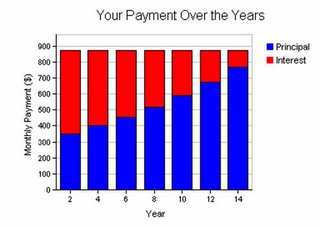
A $100,000 loan on a 30 year term at 6.25% interest.

Monthly payment: $632
Principal portion of payment: Under $95 each month for the first year
Interest portion of payment: Under $536 each month for the first year


Ok now lets take the same loan on a 15 year term.

Monthly payment: $871
Principal portion of payment: Under $350 each month for the first year
Interest portion of payment: Under $521 each month for the first year

Of course the 15 year loan will cost you $239 more per month. However, your really should consider it savings because each month you will be contributing $350 to your principle. So after the first year you will have paid off $3500 on your house vs. $1200 on the 30 year loan. If you can't afford the 15 year loan either buy a less expensive house or put more money down. The chart below shows you how after just 8 years half of your payment will be going toward principle.


I found a great morgage calculator that allows you too compare 15 and 30 year morgages all on one chart. Click here to compare

Another excellent source for morgage rates check our Bankrate.com

Tags:

Note: Morgage intentionally misspelled to assist in your search. Morgage is properly spelled mortgage.

Need help improving your credit score?
Contact the professionals!

Banner

Sunday, November 27, 2005

Paying off your credit cards getting out of debt


Paying off your credit cards, getting out of debt!
Everyone says they want to get out of debt.  How would you like to be debt free?  Most people want to end the dependancy on credit cards and payoff their credit cards. Going bankrupt is not an easy thing to do and it is even harder to do now days since the law changed last October.  Another problem is even if you do go bankrupt your creditors sell the bad debt to a collection agency for penny's on the dollar and they still come after you and hound you for the money.

I purchased John Cummuta's Transforming Debt Into Wealth program on CD. I believe it was a $36 program, I ended up selling on it eBay after I was done listening to it. It was well worth the money and the time to listen too. Her are some of the strategies in his book:
  1. First of all cut up all your credit cards except the one with the lowest interest rate. Do not charge anything that you cannot payoff that month.  
  2. The second step is to payoff the highest interest rate cards first.  This makes obvious sense but most people don't do this.
  3. Pay the minimum amount on all cards except the one with the highest rate.
  4. Pay as much as you possibly can on the card with the highest interest rate.
  5. When this card is paid off switch to the next highest card.
  6. If you continue to payoff cards the extra $20 or $50 per month from each paid off card needs to be rolled into the next card.  This will create a snowball effect that will help you pay of your debts even faster.
  7. Continue to apply this strategy until all the credit cards are paid off.  Don't get discouraged it could take you years to accomplish this.
  8. Remember: You need to stop incurring additional charges are your credit cards.  If you want to go out to a nice dinner, don't put is on the credit card.  If you are going to go on vacation make sure you can pay for it prior to going on the vacation.
  9. After you have paid off the credit cards start the same process on the car payments, boats, toys, etc.
  10. Apply the same strategy to your house.

    Remember: your life style may appear to most people that you are making the big bucks and living the high life. However, one definition of wealth is a math question, how many months can you and your family last on your current savings. If your annual expenses are $40,000 and you have $20K in the bank you can last 6 months. However, a lot of people are not even in this situation.

    The best way for you to change this ratio is for you to lower the monthly expenses by paying off the high interest credit cards and stop buying things on time. When you get to a stable point in your finances you should be able to setup your credit cards to pay them off automatically by withdraw from your checking account.