Showing posts with label Get Rich. Show all posts

Tuesday, March 04, 2008

20 Ways to Save More Money

20 Ways to Save More Money

I found and excellent ariticle over at Kiplingers magazine on 20 ways to save. Below is the article along with my comments.

You've heard of the saving crisis in America. You've probably even thought, 'yeah, I should probably save more.' But eking out an existence is tough on a starting salary and sometimes comfort takes precedence over cutting corners. Besides, if you can only save $50 or $100 a month, is it really worth it? The answer: absolutely.

I use to think that however almost 15 years ago I started saving $50 per month for my kids education. Each year when I could I would increase the amount of the monthly withdrawl. Overtime it has really added up and of course this is due to the miracle of compounding and the advantages of starting early.

By starting to save now, you're giving your money -- however little it is -- time to grow on its own. The magic of compound interest means that you can contribute less money for fewer years if you start when you're young and still end up with more cash than someone who waits.
For example, if Natasha starts saving or investing when she's 25 and saves $100 a month for ten years then lets the money sit, her stash will grow to $174,928 by the time she turns 65 (assuming an 8% annual return). If Anna waits to until age 35 to start saving, and socks away the same $100 a month for the next 30 years, she'll have only $135,940 by 65. Anna will have contributed three times as much as Natasha, but will end up with nearly $39,000 less.

It always amazes me when I meet young people who are not saving for their retirements. Start early and you will benefit greatly. Additionally, as you move along in your life you will find that even as you make more money you will spend more money. So get use to saving right away. Check out this book The Retired Millionaire Exposes Everything! Click Here! .


This week is America Saves Week, and it makes as good a time as any to get started. Think you don't have enough money to save? We've compiled a list of our best tips to find extra money in your budget to sock away. These strategies won't require you to take a vow of poverty -- we know money's tight already. Rather, they're small and simple cost-cutters that'll help you get started saving as soon as possible.

1. Give yourself a raise and bank it. Boost your take-home pay by adjusting your tax-withholding and have the difference in pay automatically transferred to an online savings account. Kiplinger's tax-withholding calculator can help you revise your W-4.

I have never been good at figuring out my with holding. So if you can do it great. What I do instead is use a special savings account which automatically pulls money out of the checking account and pops it into an account at is used for special items. For example, I use my special savings account for a Christmas fund, paying property taxes, paying for kids annual tuition bills. How many of us are still paying off our Christmas debt. If you had a special savings account your bill would be paid off or at least alot less.

2. Enroll in a 401(k). If your employer offers a 50-cent match for every dollar you contribute, even adding $60 a month will net you over a grand a year. Plus, you defer paying taxes on your contributions, giving you a bigger paycheck now.

Enrolling in a 401K is a triple whammy and that is a good thing. First of all most of the 401K have a matching plan so if you save 6% they match like 3%. Second the money you save in a 401K is tax free dollars meaning that you earned the money, banked it in the 401K without and taxes being taken out. It is the number 1 and in most cases the only tax deduction most of us have left. And finally, the third items is the money in your 401K grows tax free. Sweet!

3. Raise your car insurance deductible. Upping your out-of-pocket outlay from $250 to $1,000 can save you 15% or more off your premium.

I totally agree with the high deductible. However, I would add the following, first of all you can only raise your deductible once. I recommend that at least every 2 years you shop your car insurance around. My house insurance was $900 a year. I went to a new broker and they lowered my house insurance to $600. Then of course every year it went up, like $100 a year. So after 2 years of that I called the current broker and asked why it was going up so high and what they could do about it. The broker is an independant and they shopped it around for me. They were able to get the payment down to $575. That was even lower then where I started out 2 years ago. Pretty cool!

4. Pay off your credit card. Carrying a $1,000 balance at 18% blows $180 every year on interest that you could put to better use elsewhere.

I have wrote about paying off you debts in this blog extensively, you have to learn how to stop using credit cards and payoff your debts. First of all, don't borrow money from a credit card company. Borrow money from a bank, you will find much cheaper loans at a bank. Second don't incurr debt on something that doesn't last like a dinner out or a vacation. Who wants to be paying for last years vacation this year and you are already thing about this years vacation and the bills.

5. Go green. Control energy costs with a programmable thermostat. Prices start around $50, but you'll cut your heating-and-cooling bill by 10-20%.

Another idea, just turn down the thermostat and where a sweat shirt. Also another great way to save on energy costs is to drive slower. I use to run up and down the freeway way to fast. I back it down to 70, and you would be amazed what is does for your mileage. Also, if you don't have a garage, don't pre-start your car in the morning. This wastes a ton of gas.

6. Bundle up. Getting a package of phone, Internet and cable from one provider can save you about $50 a month.

This one really pisses me off. Our stupid cable bill is $120 a month, phone is $38 and that doesn't include cell phones. One tip I have on the cell phones, consider using a pay as you go phone with no contract. My wife has one and her cell phone bill is only $200 per year. That is only $16 a month. We buy her a $100 card when she needs more minutes and it last almost 6 months. Also, cut the long distance service on your land line. We use calling cards. It is only $.04 per minute.

7. Use your employer's FSA. Flexible spending accounts let you pay healthcare costs with pre-tax dollars. If your company offers them, take advantage and save 33% or more.

This is your second largest deduction that you can take right out of the pay check. These are tricky though, because if you don't use the money you loose the money. They also tend to be a lot of record keeping. But I still use mine.

8. Get a credit card with rewards. Spending $80 a week on gas and groceries? Putting it on a card with 5% cash rebates will earn you nearly $200 a year.

I am a huge fan of cash back cards. The caution here is don't sign up for a cash back card and then not be able to pay off your credit cards. Additionally, make sure your cash back cards don't have an annual fee. No sense in paying $100 to get $200 back.

9. Kick the habit. Smoking is hard on your health and the wallet. Three packs a week averages $50 a month. Learn more about how getting in shape can fatten your wallet.

My work is even offering cash incentives to get healthy and stop smoking.

10. Brown bag it. Instead of spending $8 on takeout every day at work, bring a bagged lunch for $5. You'll save $60 a month and $720 a year.

Eating lunch out is expensive. I disagree with the math here. I think you can bring your lunch for less than $5 and when you eat out it is usually a lot more than $8. Huge savings here when you start to cut back on the number of family dinners out. Another thing to consider is to cut back on the drinking in the bars. Have a beer at home they only cost $.50 at home and they are $3 to $4 in the bar!

11. Negotiate your rate. Instead of paying an APR of 18% on your credit card, call your issuer and ask for a lower rate. If you have good credit, your lender might consider it and if you can provide examples of offers you've gotten from other companies, it'll strengthen your case.

I recently wrote a post on negotiating with credit card companies.

12. Travel on the cheap. Bypass the old trifecta of travel search engines (Travelocity, Expedia and Orbitz) and head straight for Sidestep.com, which will search them all -- saving you money and time. For last minute deals, try Site59.com. And see our list of the 25 Best Travel Sites for more cost-cutting resources.

I recently wrote a post on finding cheaper flights. Vacations are expensive! Consider driving, not staying at a resort, you never spend time in the room anyway.

13. Insure yourself. Even if your company has a health plan, you may be able to do better for yourself. Pairing a high-deductible medical policy with a health savings account -- which lets you put away pre-tax dollars for out-of-pocket medical expenses -- can save money on premiums. Shop around at http://www.ehealthinsurance.com/.

14. Make media free. Dust off your library card and enjoy DVDs and books for free. If you'd normally rent a movie a week and buy a book a month, you can cut costs by $30.

15. Change your calling plan. The average wireless-phone user spends about $60 a month, including taxes and fees. If you talk for 200 or fewer minutes per month, switching to a prepaid plan where minutes cost 25 cents a minute could save you $10 a month. Compare plans at http://www.myrateplan.com/.

16. Park your car. Why pay $25 a week in gas when you could pay half that to use public transit? Or check out carpooling at http://www.erideshare.com/ and http://www.carpoolconnect.com/.

17. Ditch your gym. Forget the $40/month gym membership that'll cost you almost $500 a year and check out community centers in your area. Some may be free or charge a minimal fee such as $100 a year. Or buy a good pair of running shoes and work out the old-fashioned way.

18. Reshop your auto insurance. Using a comparison site like InsWeb can help you determine if you've got the best deal.

19. Learn to cook. Cooking at home saves on your food budget and it could even improve your dating prospects -- who isn't impressed by someone who can prepare a great meal? Check out Nine Ways to Get Ahead for more practical financial advice.

20. Keep track of your money. The best way to save is to know what you spend. It might not be pretty, but detail every expense for a month to get an idea of where you can cut back. Nearly everyone has some fat they can trim from their spending to put toward a savings goal.

Thanks for visiting and feel free to leave a comment or idea. By the way I am running a little survey to get my readers opinion on what items I should write more about so please take the survey, it is over on the left hand side of the page. Also for related articles check out the tags below. You might find something usefull. If you enjoyed this post please Subscribe to Strategies for Life.

Thursday, November 08, 2007

The 4 hour work week- how to quit your day job, yeah!


The 4 hour work week - how to quit your day job. yeah!

I read a great book this summer call "The Four Hour Workweek". It covers how Tim Ferriss when from making $40K per year to $40K per month. Fasinating book he covers very systematically how to get rich. His method is not easy and it is not for those who are unmotivated but it does give you a step by step plan on how to quit your day job and have a very short work week. He covers everything from using virtual assistants in India, to creating the product that make you a lot of money.

Quiting your day job is perhaps the dream of most people. How many times do you ever meet someone who really likes there day job? I only know a few people, one is a teacher at a local community college. He has great hours and gets like 5 months off per year and is usually at home by 4 pm everyday.

For more information on Tim's method's check out his website The 4 hour workweek

Monday, October 15, 2007

A dirty way to become a millionare - how to get rich

A dirty way to become a millionare - how to get rich
I saw an interesting article in the USA TODAY called, It's a dirty job, but you can get rich. Here is what the article said along with my comments.

James Dillard, owner of Dillard's Septic Service in Annapolis, Md., once rolled his company truck. In the septic business, that's about the worst thing that can happen. He was fortunate. The front of the truck wound up facing uphill in a drainage ditch and the load drained out the back and not into the cab.


An interesting way to start this article about how to get rich. It is almost like the old saying get rich or die trying. What's interesting about this article is not about how to get rich online. It is about jobs that most people don't want to do. Every wonder how many millionares there are in the lawn service and landscaping business? I remember when I was a kid I use to cut like 6 or 8 lawns a week. How many kids do you see cutting lawns now days? Not many it is mostly big companies or adults cutting lawns. Think about it the smart ones are charging a minimum of $25 a lawn and if the have more than one lawn in the area they can pull in a pretty good wage in one hour.

Dillard goes most days without getting a splash on his clothes. "The only odor you catch is when you take off the cap and agitate the solids," he says. Dillard runs a business that most others wouldn't touch. Dillard knows that, but he takes it to the bank. He understands the attitude. His father was in the septic business, and when Dillard was in school, he was a little embarrassed by him. Dillard tried other occupations, including managing a furniture store. But he has circled back to septic, where he now charges $200 to $300 a visit. At about five stops a day, his annual income passes six figures with months to spare.


The fantastic thing about this business is that is is ressession proof business. People can't stop so they are always going to need a cleaning. It's a pretty good wage, $1000 to $1500 per day.


Turns out there are a lot of people doing well by running businesses large and small that others consider mundane, boring, beneath them or downright disgusting. Their success flies in the face of perhaps the most pervasive piece of career advice out there, which goes like this: Do something you enjoy, and the money will follow. Or, work at what you love, and you'll never feel like you work for a living.


A friend of mine started a company that takes down water towers. His business now takes down over 130 water towers a year. I am not sure in this case that no one wanted to take down water towers. In this case it was just no one new how and they did.

Sunday, April 01, 2007

Hot stock tips and the latest buzz checkout Instantbull

Get the lastest buzz on stocks, find the hot stock tips

I read and interesting article about Instantbull a stock message board aggregator. Pretty cool site. Allows you to see real time chat on stock from multiple messages like Yahoo, Google Finance, and MSN. After you have selected a particular stock on the left hand side you can see all of the recent messages from all the different message boards in real time. If you just mouse over the latest message you will see that page of the message board.


It also has a cool feature that lets you instantly checkout different websites data on a particular stock. For example you can see options, cash flow and balance sheet views from mutiple sites.


Another feature that I really like on Instantbull was the Hot List. This feature allows you to see in a tag cloud which stocks are being talked about the most. The larger and bold the stock symbol the more the buzz.


Tuesday, March 27, 2007

CEO Pay Executive Compensation

Tired of your boring job? Feel like you will never get ahead? Looking for ways to increase your compensation. You need to be the CEO of the company. Executive compensation was on a tear in 2006. Here is just a snap shot of some of the highest paid CEO from last year.
  1. Merrill Lynch CEO, Stanley O'Neal $91 million
  2. AT&T CEO, Edward Whiteacre, $60 million
  3. Coca Cola CEO, Neville Isdell, $32 million
Check out this chart from the Wall Street Journal on Executive Compensation for 2006. I don't know how someone survives on $91 million a year, but I am willing to try.

Businessweek just did and interesting article on the relationship between a CEO home size and the stock performance. There study indicates that company stock of the CEOs who have a smaller home tend to do better than the ones who have the mega mansions.

Related reading: Rites of Passage at $100,000 to $1 Million+: Your Insider's Lifetime Guide to Executive Job-Changing and Faster Career Progress in the 21st Century

I hope you enjoyed this post. If you have a question or a idea make sure you leave a comment and I will try to research it and write about it. Final thought if you enjoyed this post why not Subscribe to Strategies for Life its free.

Saturday, March 17, 2007

Five Principles for Happiness in 2007

I found a great article by David Bach, author of The Automatic Millionaire, the article's title Five Principles for Happiness in 2007 focuses on The Live Rich Factor. The 5 principles of the Live Rich Factor are: millionaire millionare

Principle 1: Give Yourself a Break
Principle 2: Get Connected with Your Truth
Principle 3: Stop Judging Yourself
Principle 4: Stop Judging Others
Principle 5 : Pursue Fun with a Vengeance

Read the complete ariticle

Other books by David Bach.

Start Late, Finish Rich: A No-Fail Plan for Achieving Financial Freedom at Any Age
Smart Couples Finish Rich: 9 Steps to Creating a Rich Future for You and Your Partner
The Automatic Millionaire Homeowner: A Powerful Plan to Finish Rich in Real Estate

I would be curious about your thoughts on the article. If you have a question or a idea make sure you leave a comment and I will try to research it and write about it. Final thought if you enjoyed this post why not Subscribe to Strategies for Life it's free.

Sunday, March 11, 2007

12 Steps to becoming a millionaire as an employee


Kiplinger.com had another article that talked about becoming a millionaire while you are an empolyee. The article title Making It Big on a Paycheck by Follow these 12 steps to become a millionaire as an employee. Here is what they said with my comments.

A number of the people profiled made their millions as entrepreneurs. But working for the Man doesn't mean you have to be a wage slave or resort to buying lottery tickets to strike it rich. The trick is to maximize your income on the job (and know when to move on), make the most of your employee benefits and tax breaks to pocket more cash, and use that extra money to start investing. Here's what to do:


  1. Keep your eyes peeled for better ways to do your job. Streamline a procedure, shave costs, create a new profit center, become an expert on a specific topic, volunteer for a company committee, anything that will make you stand out as a prime candidate for a promotion or a pay boost. I wrote an article Top 11 ways to get noticed at work which covers this topic in detail. Many people will leave work right on time at 4 pm while the boss hangs out and works his but off until 5:30 pm and they wonder why they don't get ahead. You have to add value to you company. It is an information society, use your brain, think and help find a way to make the company better. Over time you will get noticed.
  2. Don't be afraid to negotiate. In a study of master's-degree graduates from Carnegie Mellon University, economics professor Linda Babcock found that those who negotiated their first salary boosted their pay by 7.4% compared with those who didn't bargain. As I have always been told you get what you negotiate. The only real time that you can negotiate your salary is when you are coming an going. You really cannot negotiate when you are already and employee, you might have a little chance when you receive a promotion but even then when you get a promotion the company already has something in mind in regards to the salary increase.
  3. Get your ducks in a row and your numbers on paper. If possible, quantify how much your efforts add to the company's bottom line. If that's not feasible, spotlight your value with comparable salaries for workers in your position from a Web site, such as Salary.com, or from a professional association. This helps prime your boss that you are really underpaid or he/she should think about a good merit increase next year instead of the 3% he/she was thinking about offering you. If your boss really values you and you know you are underpaid and now they know it. They will get the clue that you are probably looking around and might pursue outside opportunities. So, if they want you to stay they will have to figure out a way to keep you. Note: This only works for a while and you cannot continue to extort larger pay increases from you boss. It will get old and eventually the boss will grow tired of the game. If you really feel you are underpaid test your options outside of your company, see point 4.
  4. Plot your strategy when it's time to move on. Create a professional-looking page on MySpace that tells prospective employers why you're an exceptional candidate, recommends John Challenger, of the outplacement firm Challenger, Gray & Christmas. And don't neglect more-conventional networking: Join a professional association, or show up at school reunions toting business cards. I guess I would have to disagree here with the MySpace comment. There are not too many sites on MySpace that are professional in nature. You might be better off posting the resume on Monster.com or on Hotjobs.com.
  5. Milk your benefits. Contribute as much as you can to your 401(k) and other tax-deferred retirement plans. You'll not only build a bigger nest egg, but you'll also cut your tax bill. In the 25% federal tax bracket, every $1,000 you contribute to a 401(k) trims your taxes by $250. And you'll save on state income taxes, too. The goal here is to become a millionaire. You can only save so much so why allow your employer to help you get there faster. For most people the 401K is also one of their largest tax deductions and the best way to defer income.
  6. Flex your tax-saving muscle. Contribute pretax dollars to a flexible spending account to pay for dependent care or out-of-pocket medical expenses. If you set aside $1,500 per year and you're in the 25% bracket, avoiding federal income and Social Security taxes means Uncle Sam will subsidize almost $500 of your expenses. I use this all the time, the thing to be careful on is how much to save. One year we contributed $3000 because we were paying for my daughters braces. So that was easy we just submitted the bill every month. Last year I only contributed $1200 and it was difficult to spend so everyone got glasses and contacts at the end of the year to use up the funds.
  7. Review your tax withholding. If you're expecting a refund this spring, you're having too much tax withheld from your paycheck -- and making an interest-free loan to Uncle Sam. That's no way to become a millionaire. Put more money in your pocket by using our withholding calculator and then filling out a new Form W-4. I have never been very good at this. On the other hand this does have an advantage of being a forced savings. We usually apply our tax refund to paying off a debt or saving it for kids college or something else.
  8. Stash savings in a Roth IRA, if you're eligible. Withdrawals in retirement, including decades of compounded earnings, will be tax-free. This year, income-eligibility limits for a Roth increase to $114,000 for individuals and $166,000 for married couples.
  9. Invest like crazy. Don't delay. The quicker you get a jump on putting money aside, the easier it will be to stuff a seven-figure cushion. If you start at age 25, for example, investing $286 per month will get you $1 million by age 65, assuming you earn 8% annually. Most people now days to do not have pensions. You have to save your way to retirement. In general, I think you need about $3 million to retire so it is 40 years of savings and the earlier you start the better.
  10. Invest automatically, either through your employer's retirement plan or by setting up a regular deposit to a mutual fund or broker. You'll never miss the money, and you'll avoid two big mistakes: buying too much when stock prices are high and not buying at all when prices fall. Another automatic savings that I have found to be very useful is a special savings account. These accounts are great to help you pay for things like Christmas, vacations, property taxes or whatever. Don't you hate it when the Christmas bills come in January and you think how and I going to pay for these. Use a special savings account and pop in $100 or $200 per month and when January Christmas bills come you just pay them off from that account. This of course works if you have maintained a budget and have not run over the amount you have saved. Either way it helps ease the pain in January.
  11. Watch for fund fees. The more you pay, the tougher it is to earn an above-average return. The typical hedge fund, for example, takes 20% of any gains, and that's a huge hurdle to overcome. A better bet: no-load mutual funds with low expense ratios of 1% or less. If you trade individual stocks, watch those commissions. Picking the right mutual fund is always a challenge. I prefer not to pay loads on funds. Additionally make sure that you have good diversification and don't hesitate to get a good financial planner.
  12. Keep it simple. Be wary of get-rich-quick schemes or sales pitches for complex investments, such as oil-and-gas partnerships, that trade on the millionaire cachet to lure investors into buying high-fee products they don't understand. Most millionaire households accumulate their wealth over the long term by sticking to a regular investing plan in a balanced portfolio. Unfortunately there are not a lot of sure fire ways to get rich quick. If there were everyone would retire at 35 and have a great life. The number one rule of Warren Buffet is don't lose money.
I hope you enjoyed this post. If you have a question or a idea make sure you leave a comment and I will try to research it and write about it. Final thought if you enjoyed this post why not Subscribe to Strategies for Life it free. Free is good right?

Friday, February 02, 2007

Top 6 How to Finance Articles


A few great articles on personal finance that I discovered at Digg.com. The first on from Yourcreditavisor.com which is titled 102 Personal Finance Tips Your Professor Never Taught You is a great article covering everything from taxes to debt to eduction. Check it out. This article refers to what they didn't teach you in high school but I also think it refers to college as well check out 101 Financial Tips you Never Learned in High School (but should have) which is from Bankruptcy Reader. A very popular question that is usually asked by someone who doesn't have a job is how to get rich so make sure you stop by at 25 Rules to Grow Rich which is from CNN. The leasons from Mom. You know it is hard to replace good old Mom, I try to call her everyday so don't miss out on 46 Things I Wish My Mom Taught Me About Money. Everyone wants to know how to save money, so here are 88 Tips To Save Money. If your a student or a parent trying to pay for college you can go wrong by reviewing this article on 117 Creative Ways for Students to Pay for College.

Sunday, October 08, 2006

Thirty Year Mortgage vs Fifteen Year Mortgage - Financing Your Home

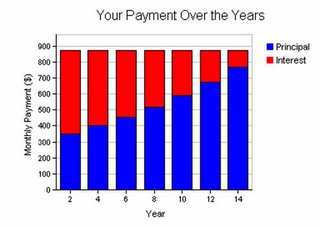
Well it only took me buying my 3rd home to convince myself that I needed to bite the bullet and get a 15 year mortgage vs. a 30 year mortgage. We have been here for 5 years now and I am really glad that we did it. I actually enjoy getting my statement each month because 2/3rds of the the payment is actually going to principle. Think about it, a $1500 mortgage payment and $1000 of it is going to principle. It is more like a forced savings program.

What about the tax savings? A lot of people might tell you that the interest on your house is your biggest tax deduction. They say that you should borrow as much as possible for as long as possible if rates are cheap, so you can get the tax deduction. I my opinion, I don't consider paying interest on a loan a good tax deduction. Why would you want to spend a $1000s to get $250 back. Why not not payoff your house and not have to pay the $1000s in interest and then you would be $750 ahead. You could take the entire house payment and buy a CD, buy an ETF, save money in your 401K, start a 529 program for your kids college education, or even purchase an investment property. Additionally, there is something of a secure feeling to me about owning your own home and paying off your debts.

One of the most important lessons that I learned later in my house buying history is the power of the 15 year mortgage. Whether it is your first house or last house try to buy the house that you can afford with a 15 year mortgage. You will be so much happier after 5 or 10 years and you decide to sell and upgrade to a larger house. Don't be worried about the fact that your house isn't as big as your friends house, think about it you won't be house poor and they will be. By using a 15 year mortgage your principle on the loan will be so much greater. Here a few examples.

A $100,000 loan on a 30 year term at 6.25% interest.

Monthly payment: $632
Principal portion of payment: Under $95 each month for the first year
Interest portion of payment: Under $536 each month for the first year


Ok now lets take the same loan on a 15 year term.

Monthly payment: $871
Principal portion of payment: Under $350 each month for the first year
Interest portion of payment: Under $521 each month for the first year

Of course the 15 year loan will cost you $239 more per month. However, as I said above, your really should consider it savings because each month you will be contributing $350 to your principle. So after the first year you will have paid off $3500 on your house vs. $1200 on the 30 year loan. If you can't afford the 15 year loan either buy a less expensive house or put more money down. The chart below shows you how after just 8 years half of your payment will be going toward principle amazing.


Not sure how all this works or how to calculte this? I found a great mortgage calculator that allows you too compare 15 and 30 year mortgages all on one chart. Click here to compare. Additionally, if you want to be able to calculate your payments on the go you should consider picking up a financial or business calculator. I love it when I go into buy a car or get a new loan and I already know what my payment will be based on the amout that I put down on the car.

How to find current interest rates: I you are trying to find the latest mortgage rates in your area I highly recommedn you check out Bankrate.com.

Related reading or listening: If you are like me you might be more of a auditory listener, that is you learn more by listening. I purchased the audio book Turn Your Debt Into Wealth by John M. Cummuta. If you are more of a reader checkout a book from the Rich Dad series called The ABC's of Getting Out of Debt.

Tags:

Sunday, September 17, 2006

Option ARM Home Mortgages Danger In the Fine Print

Option ARM Home Mortgages Danger In The Fine Print

BusinessWeek Magazine had a very scary article in the last issue about Option Arm Mortgages also know as Negative Amortization. I am always amazed when I hear radio spots advertising Smart Loans Mortgages, or Interest only loans. It is hard for me to believe that the mortgage industry keeps pitching they types of loans to the public only to create and upside-down situation in the future. How would you like to be living in Michigan right now where the unemployment rate is getting higher, housing sales are very slow, you loose your job and you find out that the balance on your mortgage is actually higher than the value of your house. That's my definition of being upside-down on your loan. It happens all the time in the car loan business. But on your house that can be a real nightmare.

Businessweek said "the option adjustable rate mortgage (ARM) might be the riskiest and most complicated home loan product ever created. With its temptingly low minimum payments, the option ARM brought a whole new group of buyers into the housing market, extending the boom longer than it could have otherwise lasted, especially in the hottest markets. Suddenly, almost anyone could afford a home -- or so they thought. The option ARM's low payments are only temporary. And the less a borrower chooses to pay now, the more is tacked onto the balance.

Home buyers need to beware the Option ARM's low installments are not fixed for the first five years like a tradition ARM or Adjustable Rate Mortgage. Since the housing boom has come to a halt and because home prices have leveled off, borrowers can't count on rising equity to bail them out. Additionally the Option ARM has significant prepayment penalties which make it costly for you to refinance and get out of the loan. Basically, it is a trap.

One example given by BusinessWeek was "Gordon Burger a 42-year-old police officer from a suburb of Sacramento, Calif., is stuck in a new mortgage that's making him poorer by the month. Burger, a solid earner with clean credit, has bought and sold several houses in the past. In February he got a flyer from a broker advertising an interest rate of 2.2%. It was an unbeatable opportunity, he thought. If he refinanced the mortgage on his $500,000 home into an option ARM, he could save $14,000 in interest payments over three years. Burger quickly pulled the trigger, switching out of his 5.1% fixed-rate loan. "The payment schedule looked like what we talked about, so I just started signing away," says Burger. He didn't read the fine print. After two months Burger noticed that the minimum payment of $1,697 was actually adding $1,000 to his balance every month. "I'm not making any ground on this house; it's a loss every month," he says. He says he was told by his lender, Minneapolis-based Homecoming Financial, a unit of Residential Capital, the nation's fifth-largest mortgage shop, that he'd have to pay more than $10,000 in prepayment penalties to refinance out of the loan. If he's unhappy, he should take it up with his broker, the bank said. "They know they're selling crap, and they're doing it in a way that's very deceiving," he says. "Unfortunately, I got sucked into it." In a written statement, Residential said it couldn't comment on Burger's loan but that "each mortgage is designed to meet the specific financial needs of a consumer."

According to the ariticle 80% of all option ARM borrowers make only the minimum payment each month. As a result of this the rest of the money gets added to the balance of the mortgage, which is called negative amortization. Unfortunately the situation gets even worse because as the balance grows after a certain point the mortgage automatically resets at a new higher payments.

In conclusion, if something seems to good to be true it probably is. Make sure before you sign up for a non-traditional mortgage of any type understand what you are getting into. For free advice take the non-traditional mortgage paper work, before you sign, to a bank and take to the loan officer. Tell them that you are considering this type of loan and you would like there opinion on the loan vs. a traditional loan that there bank could offer you. In my opinion your best bet is to stick with a traditional 30 year or 15 year fixed mortgage and pay the thing off as fast as you can.

Related reading: Check out the following books if you are interested in learning more about mortgages, The 106 Mortgage Secrets All Homebuyers Must Learn--But Lenders Don't Tell , and Mortgages for Dummies.

Final thought do me a favor. If you enjoyed this post or any of my other posts why not subscribe to my Strategies for Life Blog? Again it is free, free is good right? Just click here.

Tags: investing, retirement, get rich, mortgages

Related links:

Thanks for visiting please check out my other blogs and websites:

If you enjoyed this post please Subscribe to Strategies for Life.

Sunday, August 20, 2006

Making money online with affiliate programs

Making money online with affiliate programs

Maybe you don't have your own product or service to sell but you are still interested in making money online through the internet. One of the best ways to do this is through and affiliate program. I also like placing ads with Google Adsense as well.

What is an Affiliate Program? An affiliate program allows you to act a an agent for the participating companies. For example, Walmart is one of my affiates. If you click on the ads that if have placed on my sites and end up buying something from Walmart I would get paid. Dell is also one of my affiliates, the same goes for Dell.

Below are two examples of affiliate program ads that you can try.

Wal-Mart.com USA, LLC

Dell Home Systems

If you would like to enroll in Linkshare's affiliate program or Chitika click on the ad below to enroll.

LinkShare  Referral  Prg


Get Chitika eMiniMalls


How do I find the right Affiliate Program? The easiest way to find an affiliate program is to go to either Commission Junction or LinkShare. I have been a member of both Linkshare and Commission Junction. I am also a member of Amazon.coms affiliate program. I prefer Amazon and Linkshare because every time I join Commission Junction they kick me out because I have not produced revenue fast enough.

Final thought do me a favor. If you enjoyed this post or any of my other posts why not subscribe to my Strategies for Life Blog? Again it is free, free is good right? Just click here.

Tags: investing, retirement, get rich

Related links:

Thanks for visiting please check out my other blogs and websites:

If you enjoyed this post please Subscribe to Strategies for Life.