Rent vs. Own How Much Can you save?
I found a pretty cool interactive tool that allows you to take a look at which is financially better renting or owning. With today's declining home prices in a lot of areas it really is a tough call. You have to play around with some assumptions however, I thought it was a pretty cool tool. Calculate savings of renting vs. owning. Another big factor that I always talk about is if you are on a 15 yr or 30 yr mortgage. That makes a huge difference.
Showing posts with label Mortgage. Show all posts
Showing posts with label Mortgage. Show all posts
Wednesday, May 28, 2008


Sunday, March 02, 2008
Reverse Mortgage Troubles and Caution and how to avoid them
Reverse Mortgage Troubles and Caution and how to avoid them
I found and interesting article in the New Your Times called Tapping Into Homes Can Be Pitfall for the Elderly here is what the article said along with my comments.
Erika Baker was 67 years old, divorced and worried about her job when a saleswoman showed up at her door in late 2006. A reverse mortgage, the saleswoman explained, would give Ms. Baker instant access to hundreds of thousands of dollars tied up in the value of her home. Such a loan, typically available only to homeowners in their 60s and older, would not have to be repaid until Ms. Baker moved out, the saleswoman said. And if she never moved, the loan would be settled by selling her house after she died. “Your Home Pays You Cash!” read a brochure the saleswoman left behind.
I guess the first red flag is don't believe any sales person that shows up at your door. Also another caution is if this is your first offer as in any transaction such as a purchase or and investment you should get at least 2 and hopefully 3 offers.
Ms. Baker, who lives just outside San Diego, jumped at the offer, borrowing a little more than $200,000 through a company called Senior American Funding. Then the problems began. The saleswoman pressured her to put the proceeds of the loan into complex investments that put her money out of reach, Ms. Baker said. She received only about $33,000 in cash, far less than she needed for her final years. “I thought this was a safe way to make sure I’d never run out of money,” Ms. Baker said. “Then everything became so confusing. No matter where I turned for help, it seemed like things got worse.”
At this point the second red flag should have been waving frantically. She needed money not new investments. This started to smell like a scam very quickly.
As the United States has become an older nation, reverse mortgages have grown into a $20-billion-a-year industry, with elderly homeowners taking out more than 132,000 such loans in 2007, an increase of more than 270 percent from two years earlier. In surveys, many borrowers say reverse mortgages have improved their lives and provided money they needed for retirement.
For most people their home is their largest asset. I don't like to call it and investment because if you sell it you need to find somewhere else to live. However, it is worth something. However, most of us, especially with the recent ups and downs in the real estate business will not be able to depend on our home for a significant portion of our retirement.
But hundreds of people who have sought reverse mortgages — in lawsuits, surveys and conversations with elder-care advocates — have complained about high-pressure or unethical sales tactics they say steered them toward loans with very high fees. Some say they were tricked into putting proceeds of their loans into unprofitable investments, while sales agents pocketed rich commissions.
I feel sorry for people in these situations. You would think they would have an adult child or a friend that could review the contract with them to help them determine what they were getting it. In this case they should have consulted a real estate attorney to review the contract. I have trouble understanding terms and conditions and I would have hired and attorney for a few hundred dollars to review the contract and tell me what I am getting into.
“Every scam artist is getting into this business,” said Prescott Cole, an elder-care advocate who has worked with numerous reverse mortgage borrowers. “Because reverse mortgages are so complicated and give you money up front, years can pass before a senior realizes they’ve lost everything.”
Again focus on the term So complicated. That sounds like you so need a lawyer. Getting a lawyer involved first would have prevented the need for one later when you have to sue the company that offered you the reverse mortgage.
Reverse mortgage lenders and brokers dispute those accusations, noting that the loans are heavily regulated and have helped hundreds of thousands of people. “For a lot of elderly people, their only real asset is their house,” said Peter Bell, president of the National Reverse Mortgage Lenders Association, a trade group. “A reverse mortgage is one of the few ways someone can access wealth that’s otherwise out of reach, while still living in their house for as long as they want.”
They could also sell their house to an investor and rent it back from him. They could outright sell the house and move into an nice senior community. Lots of options you would hope. Again where is the family to help out with these decisions?
However, some borrowers find their wealth is still out of grasp, even after they have sought a reverse mortgage. For example, Senior American Funding, the company that sold Ms. Baker her loan, has been sued three times in the last 13 months by clients who said they were misled. (Two of those cases were settled out of court for undisclosed sums. The third, filed by Ms. Baker in California state court last month, is pending.) The company, which is licensed in 16 states, has originated mortgages worth more than $100 million since 2004. “We never pressure clients,” said one of the company’s founders, Matthew Copley. “We just try to make sure they know about their options.”
I don't know if I believe this, "we have never pressured clients".
However, a former sales agent, Hani Shenoda, and an agent who still works at the company who spoke on the condition of anonymity because of fear of retribution, said in interviews that managers at Senior American Funding encouraged them to pressure older homeowners into unwise loans and investments. The company disputes that assertion. On Tuesday, after being contacted by a reporter, Senior American Funding announced it would no longer sell combinations of loans and investments like the one Ms. Baker had bought. “When we make mistakes, we address them as responsibly as we can,” Mr. Copley added. Ms. Baker owned a home worth about $600,000 but was living paycheck to paycheck, teaching child-rearing skills to low-income mothers for about $400 a week, when she was told in 2006 that her job was ending.
We you see here is a problem right off the bat, a $600,000 home. Holy moly! The taxes alone on the house has to be more that she is bringing home with her $400 a week job. She should have sold the house long ago. What ever time in her life when she was able to afford that house is gone.
Months earlier, she had received a mailing from Senior American Funding, one of the hundreds of reverse mortgage companies that have emerged in the last several years. She scheduled an appointment with a saleswoman named Laurie Spencer. (Ms. Spencer no longer works at Senior American Funding, according to the company, and could not be located.) “This saleswoman was so friendly and personable,” Ms. Baker said. “It was like God had sent me a friend to tell me how to survive.” In the kitchen of the home, where Ms. Baker displays watercolors of dolphins and flowers she has painted, the saleswoman recommended a loan of $218,900, with a variable interest rate initially set at 6.57 percent.
Again what was the house worth? $600K and they were recommending $218K. I don't like the math.
Because reverse mortgages do not require borrowers to make immediate repayments, the interest charges are added to the debt every day, and the total amount owed grows over time. The saleswoman did not explain that within 10 years, Ms. Baker’s $218,900 loan could grow to as much as $400,000, Ms. Baker said. That debt would be paid by selling the house when she moved out or died.
The saleswoman also did not emphasize the high fees, Ms. Baker said. The loan’s fees cost her $17,100 — almost 8 percent of the total loan — which was paid out of the proceeds as soon as the loan closed.
To ensure that borrowers know such details, the federal government requires them to speak to an independent adviser before closing a reverse mortgage. “We make potential borrowers talk to a counselor to make sure they understand what they are doing,” said Renée Shadel, an investigator with the Washington state attorney general’s office. “These can be great loans for some people, but only if they understand them.”
But critics say these counseling sessions are often brief and unhelpful. Some elderly borrowers, for instance, said their sessions lasted only 10 minutes, rather than the 60 to 90 minutes most counselors say they need to explain the loans. Critics say some sessions are so brief because reverse mortgage companies are paying for the advice. One of the largest reverse mortgage counseling companies, Money Management International, often asks lenders to pay for providing advice to the lender’s clients, according to a company spokeswoman. Money Management International, which is a nonprofit company, received $900,000 from reverse lenders last year. By regulation, counselors may not charge clients, though they are allowed to seek support from lenders.
“Anytime anyone gives a counselor a donation, they expect a quid pro quo,” said Buz Zeman, a reverse mortgage counselor with Housing Options Provided for the Elderly, a nonprofit group financed by government grants. “The point of counseling is to make people consider other options. That’s difficult if you feel like your next paycheck relies on convincing someone to get the loan.”
A spokeswoman for Money Management International says it seeks payments from lenders because government grants do not cover costs. The group’s counselors educate clients only about how loans work and do not recommend whether to proceed, she said, adding that the average time a counselor spends with a client is 58 minutes.
“There is no quid pro quo relationship with lenders,” a Money Management International spokeswoman, Catherine Williams, said in an e-mail message, adding that clients receive the same advice whether a lender pays for the session or not. “Funding is not tied to the outcome of any case.”
Even when lenders do not pay for counseling, it can still prove unhelpful. Ms. Baker’s counseling session, which was provided by an agency that does not accept money from lenders, lasted only about a half hour, and she walked away from the conversation still confused, she said.
Then the saleswoman persuaded her to sign the loan forms.
After the reverse mortgage closed, Ms. Baker used the proceeds to pay off a $68,000 traditional mortgage on her home, and she put about $33,000 into various savings accounts.
The remaining $100,000 was used to purchase, at the saleswoman’s urging, two deferred annuities — complex contracts that offer monthly income in exchange for a large lump-sum payment. Those annuities prohibited Ms. Baker from gaining access to most of her funds for seven years unless she paid a stiff penalty.
Moreover, the annuities were likely to cost her money rather than pay her. Annuities are so complex that it is impossible to forecast precisely how much Ms. Baker will receive from them. However, based on recent payout data for similar products, she will probably earn about $520 a month from her annuities for the rest of her life. Ms. Baker’s mortgage debt is increasing by about $600 a month as the interest compounds on the money she used to purchase those annuities.
If Ms. Baker collected monthly income from her annuities for 10 years, she could receive $62,400. However, the debt she would owe over that period would likely increase by $79,000 to $300,000, depending on how her loan’s interest rate changed.
“Buying an annuity with the proceeds of a reverse mortgage is incredibly dangerous,” said Mr. Cole, a critic of reverse mortgages. Indeed, the practice is so troublesome that many annuity companies and states either tightly regulate or forbid it. The salespeople at Senior American Funding were richly rewarded for their sales: the company received about $8,750 in commissions from Ms. Baker’s annuities, and $7,200 for processing her reverse mortgage.
Last month, Ms. Baker sued Senior American Funding, accusing it of fraud and elder abuse.
Mr. Copley, the Senior American Funding co-founder, defended the company’s actions and said Ms. Baker consented to every transaction. However, Mr. Copley conceded that Ms. Baker was given documents with inaccurate numbers and that sales agents, including him, at the time did not fully understand the products they were selling her. “If we made mistakes, I’m sorry,” he said.
Other lenders have also been accused of pushing older homeowners into unwise deals.
A survey released last year by AARP, formerly known as the American Association of Retired Persons, of more than 1,500 reverse mortgage borrowers found that almost one in 10 were urged to buy other financial products, like annuities.
Lawsuits against reverse mortgage companies, including the nation’s largest, Financial Freedom Senior Funding, contend that those firms helped pressure older Americans into bad investments. In court filings, companies have denied those claims. “Financial Freedom is not involved in selling annuities, does not recommend annuities, and won’t even allow borrowers to use reverse mortgage proceeds to buy an annuity at closing,” said Joel Schiffman, the company’s general counsel. “We only pursue a reverse mortgage when it is in a senior’s best interest.”
Some regulators and lawmakers, however, have said that more safeguards are needed, including giving borrowers more information about alternatives to reverse mortgages, disclosing fees more clearly and providing more government money to counselors, so that they do not seek payments from lenders.
New laws governing reverse mortgages are under consideration in Congress, though lobbyists for some lenders are mounting strong opposition, Congressional staff members say.
For Ms. Baker, now 68, such safeguards would come too late. She says she wakes up in the night, terrified there will not be enough money for food, gas or anything else. To cut her grocery bill, she stopped buying meat and fresh vegetables. “Before, at least I knew my house was safe, and that no one would take that away from me,” she said. “Now, I don’t know if there is anything I can count on.”
Related reading:
Thanks for visiting and feel free to leave a comment or idea. By the way I am running a little survey to get my readers opinion on what items I should write more about so please take the survey, it is over on the left hand side of the page. Also for related articles check out the tags below. You might find something usefull. If you enjoyed this post please Subscribe to Strategies for Life.
Monday, February 11, 2008
Avoiding Foreclosure - Don't Lose Your Home
Avoiding Foreclosure - Don't Lose Your Home
If you are unable to make your mortgage payment here are some tips to help you avoid foreclosue.
1. Don't ignore the problem. The further behind you become, the harder it will be to reinstate your loan and the more likely that you will lose your house. Remember, banks and mortgage companies do not want to be in the real estate business. They are in the loan business. Most banks now days have special departments setup to help you work through a payment program.
2. Contact your lender as soon as you realize that you have a problem. Again lenders do not want your house. They have options to help borrowers through difficult financial times. Have a list of question ready for your call. Make sure you understand what amount you can and cannot pay at this time.
3. Open and respond to all mail from your lender. The first notices you receive will offer good information about foreclosure prevention options that can help you weather financial problems. Later mail may include important notice of pending legal action. Your failure to open the mail will not be an excuse in foreclosure court. Even if you only owe $5000 on your $200,000 home they bank still owns it and can foreclose on you. Be responsible and address the problem.
4. Know your mortgage rights. Find your loan documents and read them so you know what your lender may do if you can't make your payments. Learn about the foreclosure laws and timeframes in your state (as every state is different) by contacting the State Government Housing Office. The state of Michigan is even running special seminars on avoiding foreclosure.
5. Understand foreclosure prevention options.Valuable information about foreclosure prevention (also called loss mitigation) options can be found on the internet at www.fha.gov/foreclosure/index.cfm.
6. Contact a HUD-approved housing counselor. The U.S. Department of Housing and Urban Development (HUD) funds free or very low cost housing counseling nationwide. Housing counselors can help you understand the law and your options, organize your finances and represent you in negotiations with your lender if you need this assistance. Find a HUD-approved housing counselor near you or call (800) 569-4287 or TTY (800) 877-8339.
7. Prioritize your spending. After healthcare, keeping your house should be your first priority. Review your finances and see where you can cut spending in order to make your mortgage payment. Look for optional expenses-cable TV, memberships, entertainment-that you can eliminate. Delay payments on credit cards and other "unsecured" debt until you have paid your mortgage.
8. Use your assets. Do you have assets-a second car, jewelry, a whole life insurance policy-that you can sell for cash to help reinstate your loan? Can anyone in your household get an extra job to bring in additional income? Even if these efforts don't significantly increase your available cash or your income, they demonstrate to your lender that you are willing to make sacrifices to keep your home.
9. Avoid foreclosure prevention companies. You don't need to pay fees for foreclosure prevention help-use that money to pay the mortgage instead. Many for-profit companies will contact you promising to negotiate with your lender. While these may be legitimate businesses, they will charge you a hefty fee (often two or three month's mortgage payment) for information and services your lender or a HUD approved housing counselor will provide free if you contact them.10. Don't lose your house to foreclosure recovery scams!If any firm claims they can stop your foreclosure immediately if you sign a document appointing them to act on your behalf, you may well be signing over the title to your property and becoming a renter in your own home! Never sign a legal document without reading and understanding all the terms and getting professional advice from an attorney, a trusted real estate professional, or a HUD approved housing counselor.
If you are unable to make your mortgage payment here are some tips to help you avoid foreclosue.
1. Don't ignore the problem. The further behind you become, the harder it will be to reinstate your loan and the more likely that you will lose your house. Remember, banks and mortgage companies do not want to be in the real estate business. They are in the loan business. Most banks now days have special departments setup to help you work through a payment program.
2. Contact your lender as soon as you realize that you have a problem. Again lenders do not want your house. They have options to help borrowers through difficult financial times. Have a list of question ready for your call. Make sure you understand what amount you can and cannot pay at this time.
3. Open and respond to all mail from your lender. The first notices you receive will offer good information about foreclosure prevention options that can help you weather financial problems. Later mail may include important notice of pending legal action. Your failure to open the mail will not be an excuse in foreclosure court. Even if you only owe $5000 on your $200,000 home they bank still owns it and can foreclose on you. Be responsible and address the problem.
4. Know your mortgage rights. Find your loan documents and read them so you know what your lender may do if you can't make your payments. Learn about the foreclosure laws and timeframes in your state (as every state is different) by contacting the State Government Housing Office. The state of Michigan is even running special seminars on avoiding foreclosure.
5. Understand foreclosure prevention options.Valuable information about foreclosure prevention (also called loss mitigation) options can be found on the internet at www.fha.gov/foreclosure/index.cfm.
6. Contact a HUD-approved housing counselor. The U.S. Department of Housing and Urban Development (HUD) funds free or very low cost housing counseling nationwide. Housing counselors can help you understand the law and your options, organize your finances and represent you in negotiations with your lender if you need this assistance. Find a HUD-approved housing counselor near you or call (800) 569-4287 or TTY (800) 877-8339.
7. Prioritize your spending. After healthcare, keeping your house should be your first priority. Review your finances and see where you can cut spending in order to make your mortgage payment. Look for optional expenses-cable TV, memberships, entertainment-that you can eliminate. Delay payments on credit cards and other "unsecured" debt until you have paid your mortgage.
8. Use your assets. Do you have assets-a second car, jewelry, a whole life insurance policy-that you can sell for cash to help reinstate your loan? Can anyone in your household get an extra job to bring in additional income? Even if these efforts don't significantly increase your available cash or your income, they demonstrate to your lender that you are willing to make sacrifices to keep your home.
9. Avoid foreclosure prevention companies. You don't need to pay fees for foreclosure prevention help-use that money to pay the mortgage instead. Many for-profit companies will contact you promising to negotiate with your lender. While these may be legitimate businesses, they will charge you a hefty fee (often two or three month's mortgage payment) for information and services your lender or a HUD approved housing counselor will provide free if you contact them.10. Don't lose your house to foreclosure recovery scams!If any firm claims they can stop your foreclosure immediately if you sign a document appointing them to act on your behalf, you may well be signing over the title to your property and becoming a renter in your own home! Never sign a legal document without reading and understanding all the terms and getting professional advice from an attorney, a trusted real estate professional, or a HUD approved housing counselor.
Monday, January 14, 2008
Should you rent or own a home - buying your first house

Should you rent or own a home - buying your first house
Rent or buy, determining if you should own a home or live in an apartment. I read and interesting article in US News and World Report about determine if you should rent or buy a home. Here is what the article said along with my comments.
Real-estate agents have been pushing the virtues of homeownership since homes were invented. Or since real-estate agents were invented, anyway. Paying a mortgage, they insist, is a can't-miss investment (the tax breaks, the appreciation, the thrill of fixing your own roof!). Renting is for simpletons who don't like keeping their own money. Another thing to consider in buying a home is if you take our a 15 or 30 year loan that loan payment, providing that you take a fixed interest rate loan will stay the same forever. Your rent will not stay the same. Any good landlord should be raising your rent on a regular basis.
But does owning a home really trump renting? With the economy stumbling, house prices falling, and credit tightening, many housing experts are questioning the conventional wisdom. Remember some day you want to retire. Do you really want to be paying rent or a mortgage when you retire? "Over the last decade, it may have been true," says W. Van Harlow, an economist at the Fidelity Research Institute. "Clearly, there are periods where [the housing market] will dominate. But give this market correction another 18 months, and it may not be true anymore." A lot of people made a lot of money in real estate over the last 5 years. Of course the market was over bought and there was speculation. People that got in late got burn because they bought high and sold low. Sort of the story of my life of investing?
Not so hot. The housing boom produced endless stories of homeowners getting twice what they paid for their homes. But "prices don't always go up," says Jay Butler, director of realty studies at Arizona State University. Even a boomtown like Phoenix has seen median rates of appreciation climb only 4.6 percent a year since 1981. According to a Fidelity study published this year, the return on a dollar invested in real estate in 1963 barely beat that of a low-risk treasury bill.
When the housing market slumps—as it has every 10 or 15 years for the past several decades—homeownership becomes little more than renting, from a bank. Without appreciation, buying a $400,000 house—instead of renting the same property for, say, $2,000 a month—can turn into an expensive, potentially money-losing proposition. Part of the problem here is the $400,000 house issue. That is what got a lot of people in trouble. The $400,000 house was their first home and they could only make the payments if both the husband and the wife were working. Even worse some people borrowed money on adjustable rate mortgages that that have adjusted and now they are screwed because the payment is too high. Assuming home prices come out of their death spiral (prices fell 4.5 percent in the third quarter compared with last year), they would still have to appreciate at 4 percent every year for a decade—even if rents climbed well above the rate of inflation—before a family would save more owning than renting. An $80,000 down payment could be invested instead in a mutual fund earning 8 percent, and housing comes with myriad other expenses, from maintenance to insurance to taxes, none of which build equity. The article fails to mention the size of what you are living int the quality of life of living in a neighborhood, the fact that you have a yard for your kids to play in and so on.
Tax breaks do ease the pain. But with the average family staying in a house only six years, homeownership during a slump (especially in foreclosure pits like Las Vegas and Tampa, where prices have dropped more than 9 percent since last year) can look less and less like the American dream. Vegas, Florida, Arizona, and California where totaly over heated markets. They markets were full of speculators that were buying second homes just for investment purposes and then they go burned.
Renting, meanwhile, has its virtues. It's cheaper in the short term, it offers maximum flexibility, and it pushes the headaches of maintenance and taxes onto landlords. Remember, he can, will, and should raise the rents over the years. It can also be a sound long-term investment. According to Fidelity, if renters save even $300 a month—the difference, say, between their rent and a monthly mortgage payment—that money, invested in stocks growing at only 4 percent, could add up to $114,000 in 20 years. (And that's on top of earnings on a down payment that never had to be made.) "Over long horizons, if you reinvest the savings," Harlow says, "you're probably not going to find that much difference between renting and buying." Saving hasn't proved to be the national forte, of course. But with the bloom off the homeownership rose, it may have to be soon.
Saturday, February 24, 2007
Prepaying your mortgage to do or not to do
Interesting article over at Bankrate.com called Prepaying mortgage not a no-brainer here is what they said along with my comments. morgage motrgage
Dear Dr. Don, I have heard so many debates on paying off the mortgage versus not paying off the mortgage, but to me it's a no-brainer. I want to pay off my mortgage! Here's my plan: I have $40,900 as a principal balance and about 20 years left on my mortgage. The total principal and interest each month is $323.38. I think you should also consider how close you are to retirement. A general rule before you retire is to be debt free. If you are 50 and still have 20 years left on your mortgage you should think about getting rid of your debt before retirement. In this case prepaying your mortgage probably makes sense. morgage motrgage
According to the amortization schedule I printed out, the total interest I would pay if I continue to pay on this mortgage would be $35,038. Adding that to my principal, I would pay a total of $75,938.76 over the next 20 years if I continue my loan. It is really impressive that she is financially savy enough to do the amortization schedule and calculate the total payments over the 20 years. Most people don't know what an amortization schedule is or how they are calculated. If you need help on this please review my posts on top financial calculators.
If I pay off the loan now, I would be saving that $35,000 of interest, plus I could contribute an additional $323/month to my 401(k) at work ... which would also grow over the years, giving me, as far as I can see, a huge savings that I would not have had if I hadn't paid off the mortgage. I realize there's a tax write-off for mortgage payments, but it can't add up to the amount I'd have saved at the end of those 20 years if I pay off my mortgage! Do you agree? I'm no financial expert, but as I said, it seems to be a no-brainer to me! The key point here is that she will contribute the additional funds to her 401K. In some cases it may make more sense for a person to max out the 401K contributions first prior to paying down the mortgage. Especially if you have a low interest, like below 7%. You have to remember that if you contribute $323 to your 401K the entire amount comes off of your taxable income. Meanwhile, if you pay and extra $323/month on the mortgage you don't get any additional tax benefit. It is a difficult balance in trying to figure out what you should do.
Dear Deborah,What makes it a "no-brainer" in your case is that you're going to prepay the mortgage and then use the money you would have spent on the mortgage payment to make additional contributions to your 401(k) plan. The tax advantages of that strategy make it easier to justify prepaying your mortgage.
What's missing from your analysis is consideration of how the $40,900 used to pay off your mortgage is invested. You only look at how it generates interest savings and the ability to invest the mortgage payment. The $40,900 needed to pay off your mortgage, invested over 20 years at an after-tax rate of return of 6 percent, will grow to $135,387. The lost tax deductibility of the mortgage interest does have a cost, assuming you can use it in calculating your income taxes. I assumed that you could use it in calculating your income taxes and estimate the value of investing that tax savings over the 20-year period at 6 percent after-tax as about $20,000. So combined, the value of not paying off the mortgage early and keeping the $40,900 invested and taking the tax deduction has a future value 20 years from now of $155,387.
Since 401(k) contributions are made with pretax dollars, an after-tax sum of $323 per month can buy more than $323 per month in contributions to the 401(k) plan. I'm going to assume that $323 per month buys you $430 per month in 401(k) contributions at an 8 percent pretax rate of return. That contribution stream is worth $253,279 (pretax) 20 years from now or $189,959 after taxes at 25 percent. If your contributions are matched by your employer, the forecasted results are even higher.
Without the extra $107 per month in contributions to the 401(k) and the advantage of deferring taxes on the additional 401(k) investment, the comparison would be a lot tighter and not the "no-brainer" that you suggest.
Dear Dr. Don, I have heard so many debates on paying off the mortgage versus not paying off the mortgage, but to me it's a no-brainer. I want to pay off my mortgage! Here's my plan: I have $40,900 as a principal balance and about 20 years left on my mortgage. The total principal and interest each month is $323.38. I think you should also consider how close you are to retirement. A general rule before you retire is to be debt free. If you are 50 and still have 20 years left on your mortgage you should think about getting rid of your debt before retirement. In this case prepaying your mortgage probably makes sense. morgage motrgage
According to the amortization schedule I printed out, the total interest I would pay if I continue to pay on this mortgage would be $35,038. Adding that to my principal, I would pay a total of $75,938.76 over the next 20 years if I continue my loan. It is really impressive that she is financially savy enough to do the amortization schedule and calculate the total payments over the 20 years. Most people don't know what an amortization schedule is or how they are calculated. If you need help on this please review my posts on top financial calculators.
If I pay off the loan now, I would be saving that $35,000 of interest, plus I could contribute an additional $323/month to my 401(k) at work ... which would also grow over the years, giving me, as far as I can see, a huge savings that I would not have had if I hadn't paid off the mortgage. I realize there's a tax write-off for mortgage payments, but it can't add up to the amount I'd have saved at the end of those 20 years if I pay off my mortgage! Do you agree? I'm no financial expert, but as I said, it seems to be a no-brainer to me! The key point here is that she will contribute the additional funds to her 401K. In some cases it may make more sense for a person to max out the 401K contributions first prior to paying down the mortgage. Especially if you have a low interest, like below 7%. You have to remember that if you contribute $323 to your 401K the entire amount comes off of your taxable income. Meanwhile, if you pay and extra $323/month on the mortgage you don't get any additional tax benefit. It is a difficult balance in trying to figure out what you should do.
Dear Deborah,What makes it a "no-brainer" in your case is that you're going to prepay the mortgage and then use the money you would have spent on the mortgage payment to make additional contributions to your 401(k) plan. The tax advantages of that strategy make it easier to justify prepaying your mortgage.
What's missing from your analysis is consideration of how the $40,900 used to pay off your mortgage is invested. You only look at how it generates interest savings and the ability to invest the mortgage payment. The $40,900 needed to pay off your mortgage, invested over 20 years at an after-tax rate of return of 6 percent, will grow to $135,387. The lost tax deductibility of the mortgage interest does have a cost, assuming you can use it in calculating your income taxes. I assumed that you could use it in calculating your income taxes and estimate the value of investing that tax savings over the 20-year period at 6 percent after-tax as about $20,000. So combined, the value of not paying off the mortgage early and keeping the $40,900 invested and taking the tax deduction has a future value 20 years from now of $155,387.
Since 401(k) contributions are made with pretax dollars, an after-tax sum of $323 per month can buy more than $323 per month in contributions to the 401(k) plan. I'm going to assume that $323 per month buys you $430 per month in 401(k) contributions at an 8 percent pretax rate of return. That contribution stream is worth $253,279 (pretax) 20 years from now or $189,959 after taxes at 25 percent. If your contributions are matched by your employer, the forecasted results are even higher.
Without the extra $107 per month in contributions to the 401(k) and the advantage of deferring taxes on the additional 401(k) investment, the comparison would be a lot tighter and not the "no-brainer" that you suggest.
Sunday, October 08, 2006
Thirty Year Mortgage vs Fifteen Year Mortgage - Financing Your Home
Well it only took me buying my 3rd home to convince myself that I needed to bite the bullet and get a 15 year mortgage vs. a 30 year mortgage. We have been here for 5 years now and I am really glad that we did it. I actually enjoy getting my statement each month because 2/3rds of the the payment is actually going to principle. Think about it, a $1500 mortgage payment and $1000 of it is going to principle. It is more like a forced savings program.
What about the tax savings? A lot of people might tell you that the interest on your house is your biggest tax deduction. They say that you should borrow as much as possible for as long as possible if rates are cheap, so you can get the tax deduction. I my opinion, I don't consider paying interest on a loan a good tax deduction. Why would you want to spend a $1000s to get $250 back. Why not not payoff your house and not have to pay the $1000s in interest and then you would be $750 ahead. You could take the entire house payment and buy a CD, buy an ETF, save money in your 401K, start a 529 program for your kids college education, or even purchase an investment property. Additionally, there is something of a secure feeling to me about owning your own home and paying off your debts.
 One of the most important lessons that I learned later in my house buying history is the power of the 15 year mortgage. Whether it is your first house or last house try to buy the house that you can afford with a 15 year mortgage. You will be so much happier after 5 or 10 years and you decide to sell and upgrade to a larger house. Don't be worried about the fact that your house isn't as big as your friends house, think about it you won't be house poor and they will be. By using a 15 year mortgage your principle on the loan will be so much greater. Here a few examples.
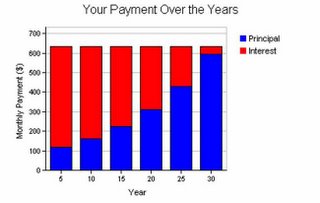
A $100,000 loan on a 30 year term at 6.25% interest.
Monthly payment: $632
Principal portion of payment: Under $95 each month for the first year
Interest portion of payment: Under $536 each month for the first year
Ok now lets take the same loan on a 15 year term.
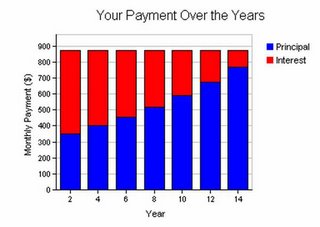
Monthly payment: $871
Principal portion of payment: Under $350 each month for the first year
Interest portion of payment: Under $521 each month for the first year
Of course the 15 year loan will cost you $239 more per month. However, as I said above, your really should consider it savings because each month you will be contributing $350 to your principle. So after the first year you will have paid off $3500 on your house vs. $1200 on the 30 year loan. If you can't afford the 15 year loan either buy a less expensive house or put more money down. The chart below shows you how after just 8 years half of your payment will be going toward principle amazing.
Not sure how all this works or how to calculte this? I found a great mortgage calculator that allows you too compare 15 and 30 year mortgages all on one chart. Click here to compare. Additionally, if you want to be able to calculate your payments on the go you should consider picking up a financial or business calculator . I love it when I go into buy a car or get a new loan and I already know what my payment will be based on the amout that I put down on the car.
How to find current interest rates: I you are trying to find the latest mortgage rates in your area I highly recommedn you check out Bankrate.com.
Related reading or listening: If you are like me you might be more of a auditory listener, that is you learn more by listening. I purchased the audio book Turn Your Debt Into Wealth by John M. Cummuta. If you are more of a reader checkout a book from the Rich Dad series called The ABC's of Getting Out of Debt.
Tags: Banking Real Estate Credit Credit Protection

What about the tax savings? A lot of people might tell you that the interest on your house is your biggest tax deduction. They say that you should borrow as much as possible for as long as possible if rates are cheap, so you can get the tax deduction. I my opinion, I don't consider paying interest on a loan a good tax deduction. Why would you want to spend a $1000s to get $250 back. Why not not payoff your house and not have to pay the $1000s in interest and then you would be $750 ahead. You could take the entire house payment and buy a CD, buy an ETF, save money in your 401K, start a 529 program for your kids college education, or even purchase an investment property. Additionally, there is something of a secure feeling to me about owning your own home and paying off your debts.
A $100,000 loan on a 30 year term at 6.25% interest.
Monthly payment: $632
Principal portion of payment: Under $95 each month for the first year
Interest portion of payment: Under $536 each month for the first year

Ok now lets take the same loan on a 15 year term.
Monthly payment: $871
Principal portion of payment: Under $350 each month for the first year
Interest portion of payment: Under $521 each month for the first year
Of course the 15 year loan will cost you $239 more per month. However, as I said above, your really should consider it savings because each month you will be contributing $350 to your principle. So after the first year you will have paid off $3500 on your house vs. $1200 on the 30 year loan. If you can't afford the 15 year loan either buy a less expensive house or put more money down. The chart below shows you how after just 8 years half of your payment will be going toward principle amazing.
Not sure how all this works or how to calculte this? I found a great mortgage calculator that allows you too compare 15 and 30 year mortgages all on one chart. Click here to compare. Additionally, if you want to be able to calculate your payments on the go you should consider picking up a financial or business calculator
. I love it when I go into buy a car or get a new loan and I already know what my payment will be based on the amout that I put down on the car.How to find current interest rates: I you are trying to find the latest mortgage rates in your area I highly recommedn you check out Bankrate.com.
Related reading or listening: If you are like me you might be more of a auditory listener, that is you learn more by listening. I purchased the audio book Turn Your Debt Into Wealth
by John M. Cummuta. If you are more of a reader checkout a book from the Rich Dad series called The ABC's of Getting Out of Debt.Tags: Banking Real Estate Credit Credit Protection
Sunday, September 17, 2006
Option ARM Home Mortgages Danger In the Fine Print
Option ARM Home Mortgages Danger In The Fine Print
BusinessWeek Magazine had a very scary article in the last issue about Option Arm Mortgages also know as Negative Amortization. I am always amazed when I hear radio spots advertising Smart Loans Mortgages, or Interest only loans. It is hard for me to believe that the mortgage industry keeps pitching they types of loans to the public only to create and upside-down situation in the future. How would you like to be living in Michigan right now where the unemployment rate is getting higher, housing sales are very slow, you loose your job and you find out that the balance on your mortgage is actually higher than the value of your house. That's my definition of being upside-down on your loan. It happens all the time in the car loan business. But on your house that can be a real nightmare. Businessweek said "the option adjustable rate mortgage (ARM) might be the riskiest and most complicated home loan product ever created. With its temptingly low minimum payments, the option ARM brought a whole new group of buyers into the housing market, extending the boom longer than it could have otherwise lasted, especially in the hottest markets. Suddenly, almost anyone could afford a home -- or so they thought. The option ARM's low payments are only temporary. And the less a borrower chooses to pay now, the more is tacked onto the balance.
Home buyers need to beware the Option ARM's low installments are not fixed for the first five years like a tradition ARM or Adjustable Rate Mortgage. Since the housing boom has come to a halt and because home prices have leveled off, borrowers can't count on rising equity to bail them out. Additionally the Option ARM has significant prepayment penalties which make it costly for you to refinance and get out of the loan. Basically, it is a trap.
One example given by BusinessWeek was "Gordon Burger a 42-year-old police officer from a suburb of Sacramento, Calif., is stuck in a new mortgage that's making him poorer by the month. Burger, a solid earner with clean credit, has bought and sold several houses in the past. In February he got a flyer from a broker advertising an interest rate of 2.2%. It was an unbeatable opportunity, he thought. If he refinanced the mortgage on his $500,000 home into an option ARM, he could save $14,000 in interest payments over three years. Burger quickly pulled the trigger, switching out of his 5.1% fixed-rate loan. "The payment schedule looked like what we talked about, so I just started signing away," says Burger. He didn't read the fine print. After two months Burger noticed that the minimum payment of $1,697 was actually adding $1,000 to his balance every month. "I'm not making any ground on this house; it's a loss every month," he says. He says he was told by his lender, Minneapolis-based Homecoming Financial, a unit of Residential Capital, the nation's fifth-largest mortgage shop, that he'd have to pay more than $10,000 in prepayment penalties to refinance out of the loan. If he's unhappy, he should take it up with his broker, the bank said. "They know they're selling crap, and they're doing it in a way that's very deceiving," he says. "Unfortunately, I got sucked into it." In a written statement, Residential said it couldn't comment on Burger's loan but that "each mortgage is designed to meet the specific financial needs of a consumer."
According to the ariticle 80% of all option ARM borrowers make only the minimum payment each month. As a result of this the rest of the money gets added to the balance of the mortgage, which is called negative amortization. Unfortunately the situation gets even worse because as the balance grows after a certain point the mortgage automatically resets at a new higher payments.
In conclusion, if something seems to good to be true it probably is. Make sure before you sign up for a non-traditional mortgage of any type understand what you are getting into. For free advice take the non-traditional mortgage paper work, before you sign, to a bank and take to the loan officer. Tell them that you are considering this type of loan and you would like there opinion on the loan vs. a traditional loan that there bank could offer you. In my opinion your best bet is to stick with a traditional 30 year or 15 year fixed mortgage and pay the thing off as fast as you can.
Related reading: Check out the following books if you are interested in learning more about mortgages, The 106 Mortgage Secrets All Homebuyers Must Learn--But Lenders Don't Tell
Final thought do me a favor. If you enjoyed this post or any of my other posts why not subscribe to my Strategies for Life Blog? Again it is free, free is good right? Just click here.
Tags: investing, retirement, get rich, mortgages
Related links:
- Interest Only Loans
- 30 year mortagess vs. 15 year mortgages
- Getting out of debt
- Finding cheaper loans
- Strategies for Life Home Page
Thanks for visiting please check out my other blogs and websites:
If you enjoyed this post please Subscribe to Strategies for Life.
Subscribe to:
Posts (Atom)